Jealousy is one of those “negative” human emotions which can make people uncomfortable.
Yesterday, the members of my therapy group discussed jealousy without judgment. Any jealousy about that?
I doubt there’s any jealousy about my handwriting and drawing abilities. This is what I wrote, yesterday, about jealousy:
Jealousy is a human emotion. I am afraid of other people’s jealousy — I’m afraid the feeling is going to hurt me. But other people’s feelings and thoughts cannot hurt me.
What makes jealousy worse for you? Lack of self-care. Cognitive distortions. Fear. $ Money.
What helps you deal with jealousy? Self care. Recognizing it’s just a feeling. Leaning back and letting jealousy go by me without hurting me.
What are your thoughts and feelings about jealousy?
Do you have jealousy about any of my other photos from yesterday?
Comparisons — the thief of joy — can often lead to jealousy.
Any jealousy about my having a wonderful son, who is turning 19 today and whose YouTube video has 90,000 views this morning?
Any jealousy about all the gratitude I have for everyone who helped me create this post and — of course! — for you?
Earlier this year, two days before I tried out for the TV show The Voice, I wrote a post titled “Comparisons.” Because comparisons are a cognitive distortion that can lead to envy, dissatisfaction, low esteem, disappointment, and misery, I hesitate to compare today’s post with the one I wrote before.
Since I’ve been back at work after my two-month medical leave, several people I’ve seen in therapy sessions have presented as unhappy due to comparisons with other people. Indeed, yesterday I circled “comparisons” on the list of cognitive distortions displayed on the wall of my office, because that particular cognitive distortion seems incomparably toxic.
Here’s a definition of the cognitive distortion of comparisons:
Comparisons.
We compare ourselves to others, with ourselves coming out short. For example, “I’m not as smart (or good, competent, good-looking, lovable, etc.) as that other person.” Or, we compare ourselves to how we think we should be, or how we’ve been before. We might think that comparisons help motivate us, but they usually make us feel worse.
I don’t want to compare myself to other people, but I’m wondering whether others ever make the kinds of comparisons I’ve been making lately. These comparisons have included:
comparisons to people who are healthier,
comparisons to other blogs with higher readership,
Apparently, I remind people of many other people. Most recently, somebody in one of my therapy groups said I reminded her of Loretta LaRoche.
Loretta LaRoche DOES remind me of me, in this way: Neither of us have our own Wikipedia page.
Here’s a YouTube video of Loretta LaRoche reminding us of stress and humor:
I don’t really remind me of Loretta LaRoche or any of the other people I remind others of, except for the important reality that we’re all human beings and therefore connected and similar in many ways.
At the same time, it’s human and expected that we’ll remind each other of other people. I think that’s a good thing and when that inevitably happens, I remind myself to take those reminders as compliments.
Do people tell you that you remind them of other people? Who are those people?
What do these images — all of which I was reminded to take yesterday — remind you of?
This all reminds me that I’m quickly approaching my 1000th consecutive daily post. That reminds me of how illuminating, helpful, and healing my blogging reminders have been for me, every day since January 1, 2013.
You, my readers, constantly remind me of how grateful I am for everything that’s happened here over the last 995 days.
Now I’m reminded to thank Loretta LaRoche and everybody else — especially you! — who remind me to keep going — with humor, authenticity, and persistence — as best I can.
(Do I need to remind you that all your thoughts and feelings about today’s reminding post are welcome?)
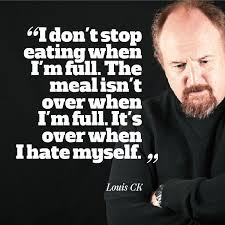
Last night, I missed a segment of the Emmy awards on TV. After I turned off the TV to spend some time with my son, Aaron, and my boyfriend, Michael, a comedian I admire, Louis C.K., won an Emmy for best comedy writing.
I found the photo, above, through Google images (which tells me it resides here) and chose it because I think it relates to my post, yesterday.
I found out, after the awards show was over, that Louis C.K., in his acceptance speech, had thanked another comedian I admire, Ron Lynch …
… who has made multiple recent appearances in this here blog ( here, here, here, here, and here).
I was very glad to find out, through Ron’s Facebook Page, that he had gotten that recognition last night. At the same time, I had this familiar and uncomfortable thought:
I missed out.
I had missed out on the chance to experience, with my son, Louis C.K. giving credit to Ron.
Last night, as I tried to find out what exactly Louis C.K. had said about Ron, I kept thinking about What Might Have Been. I kept imagining what fun Aaron and I might have had, if we had heard that speech as it was happening.
Those thoughts didn’t feel great, I must say. And these days, whenever I’m feeling that kind of psychological discomfort, I check out some usual suspects: Cognitive Behavioral Therapy’s line-up of cognitive distortions.
Hmmm. It looks like I was experiencing more than one cognitive distortion last night, including:
Negative filtering (also known as “Disqualifying the positive”).
This is when we focus on the negative, and filter out all positive aspects of a situation.
Comparisons. We compare ourselves to others, with ourselves coming out short. For example, “I’m not as smart (or good, competent, good-looking, lovable, etc.) as that other person.” Or, we compare ourselves to how we think we should be, or how we’ve been before. (Or, in this case, we compare reality to what we think would have been better.)
Shoulds. We have ironclad rules about the behaviors of ourselves and other people. For example, “I really should exercise. I shouldn’t be so lazy.” (In this case, “I shouldn’t have turned off the TV.”)
Yep. Those kinds of thoughts didn’t help, at all.
As I’m writing this, I’m still wondering what Louis C.K. said about Ron. There was no video of that missed moment available last night, but I wonder if that’s changed, this morning.
Minds are funny things, aren’t they? They wander everywhere: into the future, into the past, into What Might Have Been, etc.
Last night, when I was thinking about “What I missed,” I had some trouble sleeping, so I wrote the following, in preparation for today’s blog post:
The reality is that no matter what we’re doing, experiencing, paying attention to, focusing on … we have to be missing something. There’s just too much going on, out there, to take it all in.
Yes, it’s a given that we will miss things, even if we try our best not to.
And I don’t want to miss expressing this: the things we miss aren’t actually more important than the things we catch (even though they can feel that way).
Does it help to acknowledge important things you’ve missed out on?
I actually don’t know if this is going to help, but I would like to list some things I’ve missed out on, in my life.
Here we go …
A “normal” childhood.
A magna cum laude, which I deserved, from my undergraduate university (a story which I will tell, in some future post).
Hmmm. That’s a pretty short list I just put together, there.
That actually surprises me, because I’m sure there are lots of misses missing from that list. For example, I didn’t include “a boyfriend during junior high and/or high school” in that list of misses.
Actually, I could even remove #1 from that list because, really … WHO has a normal childhood? What the hell IS a normal childhood? Coming up with a definition for THAT would be hit-or-miss. And pretty meaningless.
So I’m going to rewrite that list, like so:
Things I’ve Missed
Louis C.K.’s acceptance speech at the 2014 Emmys, which included a shout-out to Ron Lynch and
a Magna Cum Laude, which I deserved, from my undergraduate college.
Actually, now that I think of it … what good would that Magna Cum Laude have done me? It probably would NOT have changed a thing. Who cares? It’s not like that’s something I would carry around in my wallet or put on my mantle piece. And even if I did, who would want to see it?
Okay, so now the list is …
Things I’ve Missed
Louis C.K.’s acceptance speech at the 2014 Emmy’s which included a shout-out to Ron Lynch.
And I can probably watch that speech on YouTube, within the next couple of days.
Looks like at least one of my thoughts, last night, was correct.
Anything else I’ve missed, in this post? Well, if I were paying attention to what I wrote here, the answer might be:
Of course I missed something, but that’s okay.
And I still have time, before I publish this, to include something that feels “missing” to me: a new photo I’ve taken recently. Let’s see if I have anything on my iPhone that applies to today’s topic.
Hmmm. I’m not sure. But here are some new photos I’ve taken since I’ve returned home to Boston, after five fun-filled days at the Edinburgh Festival Fringe:
Does it seem like I’m missing anything?
Thanks to Aaron, Michael, Louis C.K., Ron Lynch, and you — of course! — for everything you missed AND everything you got here, today.
The title of this post was inspired by an e-mail I got from somebody, last week.
This person had e-mailed me a question, asking about possible therapy supports for someone. When I didn’t answer back within a day, she sent me another e-mail, starting with the title phrase — “Friendly reminder” — asking for the information again.
I took note of that, because quick responses are something that matter to me, a lot.
I sometimes feel a lot of stress, when I don’t get back to people quickly enough. That’s true at work and elsewhere (including here in the blogosphere, I must confess).
Of course, that leads to the question, “What is quickly enough?” My supervisor, at work, has suggested that I ease off on myself, and allow myself more time and room to get back to people. That’s always an important, friendly reminder from her, because, in my work, a lot of people ask me questions, looking for help, every day. And I CAN’T get back to everybody as quickly as I would like. It’s impossible.
That’s an ongoing struggle for me — to allow more space and time for myself to respond. I need to remind myself that — while I’m not responding back as quickly as I would like to — it’s the best I can do. I’m only human.
But I struggle with that, a lot. And when I’m feeling down about myself, I label myself as “not responsive enough.” (And other harsher things, which I won’t name here.) (However, I will direct you to this list, for a friendly reminder about cognitive distortions including “labeling.”)
(Strangely enough, in my two yearly reviews, “responsive” was a word that people used, many times, describing me. That surprised me, each time, because it didn’t match my own wishes and expectations for myself.)
One thing I’ve considered: maybe I want to respond quickly to people because that’s what I WANT FROM OTHERS.
I’m sure that’s true. And my own yearning for quick responses? It’s based on old feelings and experiences. When I was a kid, I needed people to respond quickly, when I was in pain, and they didn’t.
I’m sure I’m not alone, in that experience (even though the circumstances may vary).
Another thing I’ve noticed: I’m more forgiving of other people’s non-perfect responsiveness, than I am of my own.
I’m sure I’m not alone in THAT, either.
So, to get back to the beginning of my post: Somebody, last week, sent me an e-mail saying “Friendly reminder,” when I didn’t respond to her initial request within a day.
And this was my reaction to that:
Wow!
And what did “Wow!” mean? Lots of things, including:
Gee! She has some nerve, asking for me to respond that quickly. Doesn’t she know I have LOTS of requests, every day?
I wish I could ask for something I need, with that kind of nerve.
That’s really an effective way to express that need. (My proof of that: my first, annoyed response faded within seconds).
Obviously, her need was more critical than I realized at first.
I want to learn from her, and use that phrase when I’m feeling the need for a quick response.
And then I responded back to her, very quickly, and I was happy to do so.
Okay! It’s time to look for photos on my iPhone, to adorn this post before I end it.
Actually, when I take a photo, it’s a friendly reminder to self: “Share this image with somebody, some day.” I do give myself space and time, with those reminders. I don’t pressure myself. I know I have all the time I need, to decide when to share those images.
Here are the photos whose times have come, today:
Friendly Reminders: A Photo Essay
by Ann
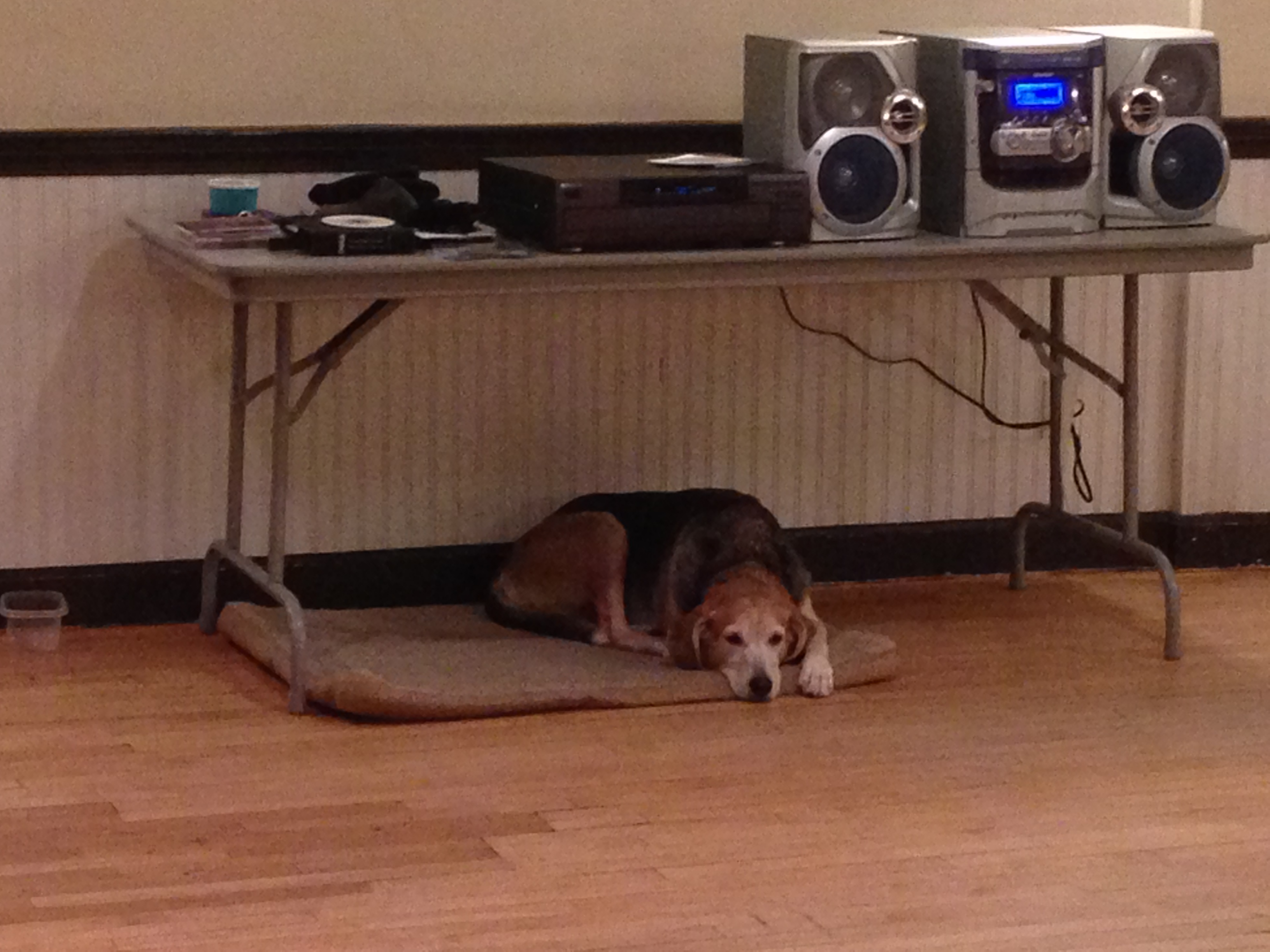
That photo is a friendly reminder that our last Argentine Tango lesson is coming up, this Wednesday. That’s Chloe, the instructor’s dog, who has been attending dance classes for many years. Because she’s watched so many dancers, I’m assuming Chloe may be better* at the Tango than I am, at this point.
Friendly reminder to self: Decide whether to sign up for more tango lessons.
.
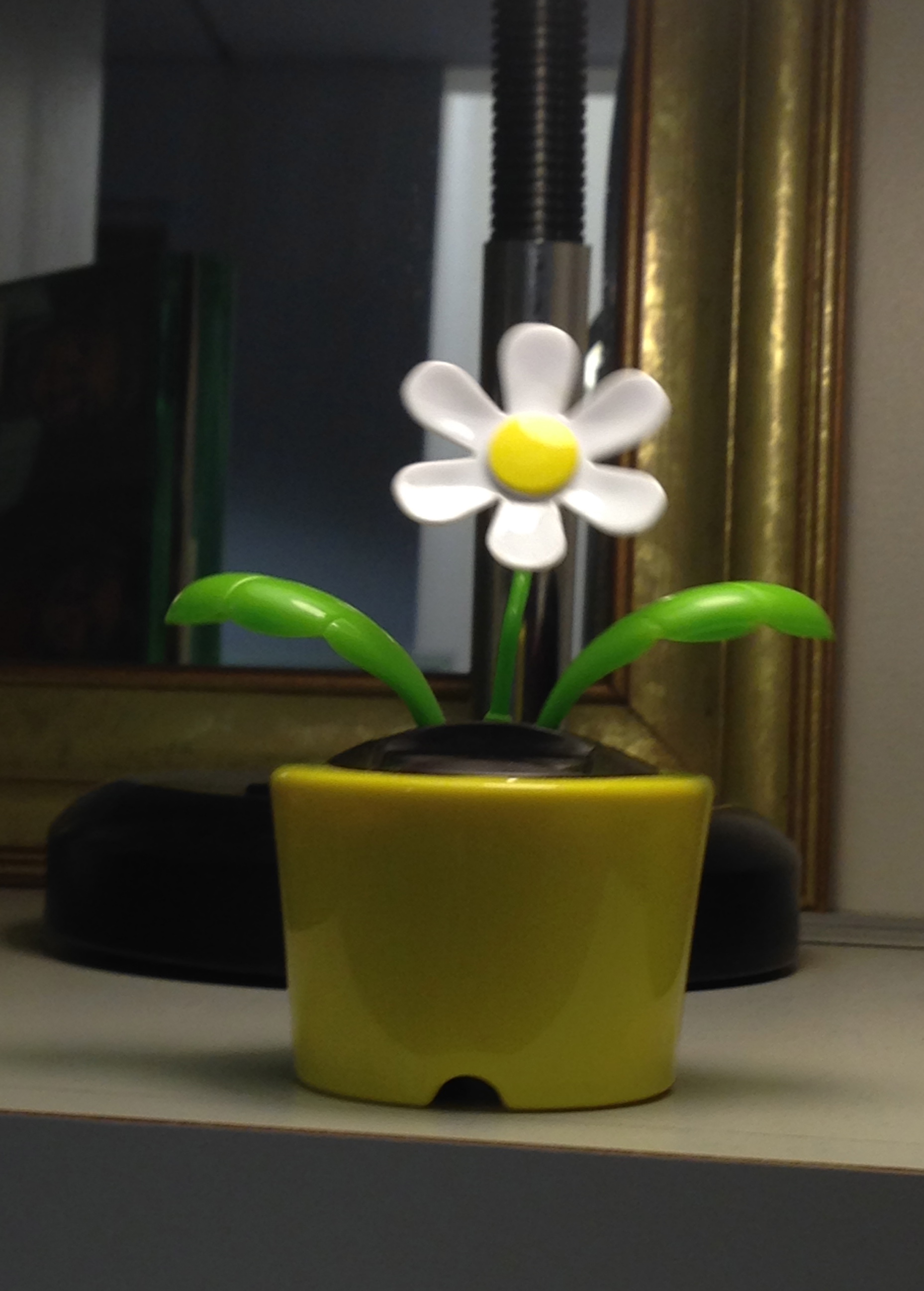
When I was walking around the hospital where I work, yesterday, I saw this at somebody’s work station and quickly snapped this photo. That flower looks blurry, not just because of my hurriedness in taking the photo, but also because that friggin’ flower was DANCING. There was no sound or music of any kind, but that flower just wouldn’t stop.
Friendly reminder: When people are doing challenging work, with no windows in sight, it helps to remember flowers. And dancing, too.
.
Here are the plants outside my office, photo also taken yesterday. If you look at the far right of that photo, you may be able to see the bird that appeared in a previous blog post, here.
Friendly reminder: the holidays are approaching.
–
Last photo, taken before I started this post this morning:
Friendly reminder: More snow is coming soon, to many neighborhoods near me.
.
Thanks for reminders — friendly and otherwise — and for all of you reading today.
_________________________________________
* For those of you who are keeping score on Cognitive Distortions, there’s another one: Comparisons.
Last night, my son and I arrived at Logan Airport in Boston, one hour later than expected, after flights from Edinburgh and London. Speaking for myself (which is always a good idea, I think), I was exhausted, done with flying (at least for the day), and relieved to be home safely.
In the grand tradition that I’ve established whilst blogging on vacation, I will try to write a short post before venturing out to enjoy what looks like a beautiful day in these local parts.
The structure for today’s post? It’s a list of Pros and Cons (which many people find to be a helpful technique for decision-making and moving forward).
Returning Home to Boston from London and Edinburgh
(An Exceedingly Brief List of Pros and Cons)
Con (for returning home): People in the Boston area, in comparison to people we’ve seen during the last week, seem a tad more conventional and a little less colorful.
I will illustrate this with some photos I took yesterday in Edinburgh, shortly before we left for the airport:
However, as with any kind of judgmental comparison, my assumption here might be unhelpful and erroneous.
For example, some of the people in the photos above might actually BE from the Boston area.
Also, that last photo? That’s a troupe of people performing Stephen Sondheim’s musical “Assassins.” As I told one of the troupe members yesterday, while I regretted that we had to miss their performance, we had just seen — within the last month — a wonderful production of that same musical.
Where? In Watertown, MA.
.
Pro (for returning home): There are creatures here at home, who seem really glad that I’ve returned.
Here’s an example of just one of those creatures, right now:
While this “Pro” might involve some mind reading on my part, I will end this post by speaking for myself, once more.
I’m really glad to see them, too.
Thanks to all the lovely and interesting creatures in Edinburgh and in the greater Boston area, to Stephen Sondheim, to my favorite kind of egg (whether it’s called “sunny-side up” or “fried”), and to you, for reading today.
Last year, my first review helped me, big time. My anxiety about being at work went waaaay down. I let go of self-doubt, self-criticism, and all sorts of cognitive distortions, like Comparisons, Mind Reading, and Negative Filter :
Negative filtering (also known as “Disqualifying the positive”).
This is when we focus on the negative, and filter out all positive aspects of a situation. For example, you get a good review at work with one critical comment, and the criticism becomes the focus, with the positive feedback fading or forgotten. You dismiss positives by explaining them away — for example, responding to a compliment with the thought, “They were just being nice.”
It’s interesting that the example of negative filtering, above, is a work review. And here’s the deal: my first review had no negative comments. Not one.
So I really let in all that positive feedback and compliments last year. And it made a huge difference.
Essentially, that first review was a healthy, mega-dose of Reality Testing:
Reality testing. Ask people questions to find out if your thoughts and concerns are realistic or true. This is a particularly effective response to the distortion of mind-reading.
It was an antidote for my negative self-talk, fears, projections, and other unhelpful thoughts I was having about work.
This year’s review focused more on Ways I Could Improve. And there was a thing, or two, about that review which I could — if I chose — use as a negative filter. I could maximize the “negative” and minimize the huge number of positives that were there.
But I’m not. Instead, I am letting in all the amazing, positive comments I got, from people I respect, a lot.
And, again, it’s making a big difference.
I feel more alive, secure, and eager to go into work this morning. I feel confident that — no matter what challenges arise, no matter what mistakes I inevitably make — I will do a good enough job.
My passion and love for my work is unhindered, this morning, by any dread, guilt, or anxiety.
And nothing has changed, people, about my work situation.
The only thing that has changed is this: Today I know some beautiful details about how my work is appreciated.
Before I came to this job, I worked at a place where I also loved what I did. However, I received only a couple of formal reviews during the twelve years I was there. I still got positive feedback and encouragement from wonderful people, but I didn’t get that bracing mega-dose of appreciation…. until I left.
And those Goodbye Appreciations were, again, an incredible remedy for what ailed me.
Here is the point I want to make this morning:
Confidence helps.
While we may have fears of feeling too good (discussed here, here, and here), and while we might love and admire the quality of humility in others and in ourselves …
Confidence helps.
I know it helps me, in so many ways.
It helps me do a better job.
It helps reduce my anxiety.
It helps me express myself, more strongly.
It helps me feel more comfortable, exactly where I am.
And instead of feeling like I have to be a Kingpin to succeed, I feel more connected to my team:
(Seen yesterday, as I walked away from a Good Day’s Work.)
.
Thanks to my teams at work, to people whose work includes dressing up like giant objects like teeth or bowling pins, to yearly reviews, and to you.
When I orient a new person to my therapy groups, I do a 30-second speech about The Group Experience, which goes something like this:
One of the most healing things about working with a group is realizing that you are not alone in having certain thoughts and feelings. There will also be times when you’ll realize you’re the only one who has had your unique experience. When that happens, know that you are not alone with that, either.
Because I’ve been experiencing disappointment — in myself and in others — I’ve been feeling alone and isolated lately, even while surrounded by other people.
My thoughts have turned negative. Challenges and obstacles seem overwhelming.
I’m thinking:
Why bother? This is too hard. I’d like to think that what I’m doing and what I have to offer matters, but — ultimately — it doesn’t. People let me down. I let other people down. I’m tired of trying, with so few results. Other people seem to have it easier. Other people don’t really care. Even if they did care, they can’t help me in any real way.
I’m alone in this. And it feels like it’s too much for me.
When other people express thoughts like those to me, there are lots of ways I respond back.
Sometimes, I just listen.
Sometimes, I point out “cognitive distortions” in that kind of thinking (such as fortune telling, mind reading, comparisons, all-or-nothing thinking, etc.).
Sometimes, I reflect back how it makes sense that the person is feeling depleted, less hopeful, discouraged, and disappointed — because of stressful external realities as well as the person’s internal memories, assumptions, and experiences. (And I do have several stressful things I’m dealing with right now, including creating and presenting a new workshop this weekend at a conference for “experts”, which intimidates me.)
Sometimes, I just try to make it safe enough for the person to have all their feelings when they are in a difficult, darker place.
I guess that’s the best we can do, sometimes, for ourselves and others. And to know that even when we feel most alone, we are in the presence of others.
I’ve been struggling to get enough sleep lately. I seem to be a person who can function pretty well without enough sleep.
(Sometimes I think the world is divided into two types of people: (1) People who can function “well enough” without taking care of their sleeping needs and (2) People who can function well enough without taking care of their eating needs.)
(Sometimes I think the world is divided into two types of people: (1) People who think that the world is divided into two types of people and (2) People who don’t.)
So even though I am used to functioning without enough sleep (by the way, I CANNOT function without enough food), I still feel pretty lousy when I get less than 6 hours of sleep a night. And getting 6 hours or more has been a problem for me lately.
I know a lot of people who struggle with sleep issues. It seems to me that this might be an epidemic — although I’m not an expert about sleep, by any means.
Speaking of being an “expert”, I plan on writing a future post about Experts — and the punchline for that post will probably be something like this: We Are All Experts, But Only of Our Own Experience.
So while I’m not a Sleep Expert, I am trying to access, right now, my expertise about Sleep and Me.
And expertise starts with looking at data and history.
So that means that, in order to improve my sleep, I might start by looking at my history of sleep issues.
But I’m resisting doing that right now.
That resistance probably has to do with my preference — or tendency — to focus on the present moment rather than focusing on the past.
That preference — for the present over the past — might have to do with several things, including my perception that I don’t have a good memory.
Pardon me while I indulge in a rather long digression about that thought: I Don’t Have A Good Memory. However, you might find this digression useful — since it will reference several Cognitive Distortions, all listed and defined here.
Digression about the thought that I Don’t Have a Good Memory.
This thought is probably an unhelpful piece of self-judgment, which seems to involve several cognitive distortions, including Labelling. Because what does “not having a great memory” mean? Does that mean I think that my memory is not as good as most other people’s? If so, that thought involves the cognitive distortions of Comparisons AND Mind Reading. Also, now that I think about it, I do have some data — from cognitive tests I’ve taken — that indicate that I have a Very Good Memory, although I seem to have trouble holding on to that data. (More proof that I have a bad memory?) (Kidding!) . Also, maybe I’m comparing my memory now to how my memory used to be when I was younger, another form of the distortion of Comparisons.
Shorter digression about the thought (expressed 4 paragraphs before) that I Tend to Focus on The Present Moment Rather Than On The Past.
It’s not all or nothing. (Wouldn’t you know it? This is related to yet another Cognitive Distortion.) That is, I don’t have to look at the past OR the present. I can look at both the past AND the present when I’m working on growth and healing (in myself and others).
Hmmm. I got pretty caught up in those digressions, where I noticed and challenged some cognitive distortions. Is it possible I can find my way back to The Topic of Sleep, and finish this post before I leave for work?
I think I can. Here are some things I know, this morning:
Most nights, I am not getting enough sleep.
I have had some resistance to looking at this issue.
I deserve to get enough sleep.
I would like to get enough sleep.
I can access my own experience and expertise about this issue.
I can also seek help — from people who have expertise about sleep — to work on this issue.
Wow. As often happens when I write a post, the post goes places I don’t expect.
However, where the post is ending up, this morning, relates to a wish I made as I was writing it.
I wish that I could get more sleep.
I think I’ve taken some steps — and identified others — in this post, which may help me move towards that wish.
So I chose — soon after I woke up this morning — the topic I wanted to attempt today. Soon after I made that decision, I wrote out the title “The Effect of Attention” and I thought — Whoa! That’s a huge topic. So I may just skirt the surface of this interesting topic today. We’ll see.
The inspiration to write about The Effect of Attention came from some aspects of the groups I’ve started at the hospital where I work. I wrote about these groups in this blog, on Day 13, as follows:
Here’s how these groups are different. People, once they are oriented to the structure and guidelines of the group, can attend when and how often they choose. If you were attending these groups, you would never know for sure who was going to be there when you showed up — you might know some people but other ones would probably be new. And, you’d have control over when and how often you attend. You could come once a week, once a month, whenever you wanted. You could book a space way ahead, decide to come spontaneously (if space was available), and cancel if you couldn’t make it.
(Hey! There’s another first! That is, I just quoted myself for the first time, here in the Blog of Living Non-Judgmentally.)
Anyway, so once people are signed up for these groups, they can attend as they please. And that means that at any particular group meeting, there may be lots of people and there may be very few people, or somewhere in the middle. And I’m just getting these groups going, so — inevitably — for some sessions, nobody may show up. Or ONE person may show up. And people may argue that one person is NOT a group, but, in order to keep the benefits of flexible scheduling, I need to allow for that possibility.
So this is the way I have dealt with all this. I make it clear to interested group participants — before they get into the group — how the attendance will vary. I assure them that the group is designed to work, no matter how many people show. And if one person shows up, that person will get a personal training session. (Sometimes I feel like I’m doing an infomercial when I’m talking about the groups. “No matter who shows up, satisfaction guaranteed! Wait, there’s still more! Act now and you might get THIS VALUABLE BONUS — 90-minutes of PERSONAL TRAINING with fabulous group therapists!”)
Anyway, this group model has been working well enough. However, I recognize that the number of people that show up to a session has an effect on the group members. For example, if very few people show up for a group, thoughts like these may very well occur to people:
Geesh! What the hell is going on here? Does the number of people here mean that something I said in a previous session made everybody stay away? OR does this mean that our group leader SUCKS? Eeeek!
And what if lots of people show up? If the number of group members seems like TOO MANY for a group (according to somebody’s personal judgment), these thoughts might occur:
Geesh! What the hell is going on here? Does that mean I won’t get a chance to talk? And with all these people, chances are greater that somebody is NOT going to like me (or I won’t like them)!! Eeeek!
(For those of you who are reading this blog regularly, if you noticed the distortion of mind-reading above, you get Bonus Points! However, as people often point out to me, sometimes our guesses about what other people are thinking might have validity. The antidote to mind-reading is reality testing, something I like to do, a lot.)
So, now, at this point in this post, I would like to circle back to the title of this blog: The Effects of Attention.
If somebody shows up for the group by themselves, they are going to get a hell of a lot more attention than if there are 12 other people in the room.
And I think we all have different levels of comfort with the amount of attention we receive. I’ve noticed that some of us are more self-conscious than others, and would do ANYTHING to avoid a lot of attention. And I’ve noticed — on the other end of that scale — that some of us LOVE attention. The more, the better.
I think I go up and down on that Attention Reaction Scale, depending upon a lot of things, including (1) my comfort with myself, (2) how deserving I feel of the attention, and many other factors. (See, I KNEW this was a big topic!)
And I’ll share with you a memory I had about this issue of attention, when I decided to write about this topic today. This memory came up because only one person did show up for a group yesterday, and I’m not sure how many will show tonight. (It looks like two people, so far, but because people can schedule until the last minute, so it may be more. Or even much more.)
Anyway, here’s the memory. About three years ago, I signed up for a 6-week yoga class that was offered for the staff at the mental health clinic where I was working. Now, I’ve never done yoga. And I have these judgments about myself, regarding my extreme lack of natural ability to engage successfully in Physical Exercise Classes of any kind. (These judgments might be related to my experience growing up. Because of my heart issues then, I did not take gym the entire time I was in school. And, as far as I heard from everybody else in my school, people thought I had Won The Luck Lottery, getting out of gym that way. But this had an effect, I’m sure. )
So the first time I went to the Yoga Class, I definitely had moments where I felt completely incompetent and self-conscious, because I just could not follow the Yoga Teacher’s instructions. And I compared myself to everybody else in that class, who all seemed to be doing it perfectly, as if I had missed a previously scheduled Dress Rehearsal on how to do the class. Yes, I remember feeling pretty awful at some points during that first class. And I didn’t want to go back.
I think I did go back several times and — again — I felt like I had missed the Dress Rehearsal for that class. When I tried to do the Dog Pose, everybody else looked like Pure-bred Golden Retrievers and I looked like a mangy mongrel. Actually, I don’t think I even looked like a dog, or any other living, breathing animal. I think I looked like an illustration of How Not to Do Yoga. (Well, what can I say? This happened three years before The Year of Living Non-Judgmentally.)
And I’m now approaching the end (and the point) of this story. I went to the last session of that 6-week yoga class, feeling kind of dejected and fearing the amount of shame I might feel that night. And I was the only one who showed up. And I had lots of thoughts, like, “Geesh! What does this mean? Does this mean other people don’t like this teacher? I don’t think so, but how is this going to effect the teacher? Is she going to take it personally? And how is that going to affect her tonight?” But while these thoughts were coming up, I also knew that a lot of the staff where I worked were dealing with lots of deadlines. And who knows what else might have been keeping people away? (Now that I think of it, I see this all the time: some people tend to avoid the last meeting of anything).
So, anyway, I remember consciously trying to let go of the anxiety I was feeling about being there, just me, with ALL of the Yoga Teacher’s Attention. And here’s the punchline: It was a wonderful experience. I got a lot out of it. I remember feeling safe enough with her that I got in touch with some old shame about my physical capabilities. And I cried. And I did the dog pose. And I looked enough like an actual mammal, if not a dog. And I felt fine and accepting of exactly where I was, Yoga-wise.
Wow, this was a long post, wasn’t it? I should warn you, dear reader: Thursday’s posts are probably likely to be longer, because I can go in to work a little bit later. I can go in later, because I stay late, running a group.
Gee! I wonder how many people will show up tonight?