I said that to a woman, in a therapy session, a few weeks ago.
We don’t have feelings until we’re ready for them.
I believed it when I said it, too.
The woman told me she found this a useful phrase, since she’d been crying a lot lately. I could see her letting go of the fear of her own feelings, in that moment.
I remember, many years ago, somebody else explaining to me why she never cried, with this:
One of my tears would flood the world.
I’ve heard people say similar things, like this:
I fear if I start crying, I will never stop.
I’ve been crying a lot lately. I’ve been crying in my office. I’ve cried in a meeting with co-workers. I’ve cried walking down the hallway of the hospital where I work, talking to my manager.
People don’t seem to be worried about me, which is kind of amazing.
I’ve had moments where I’ve wondered if I — and they — should be worried about me.
Am I breaking down? Is doing work that is so important to me, in a place that triggers some painful childhood memories, too much for me right now?
Or am I just having some feelings that have been there for a long, long time, because I’m ready for them? Is it possible that for the first time in my life, I feel safe enough to have them?
Are my tears a sign of healing or a warning sign?
Today, I honestly don’t know.
Maybe it’s not an either/or question. Maybe my tears are a sign of healing AND a warning sign.
So where does that leave me, today, at the beginning of a three-day vacation, after a week at work where I felt so friggin’ overwhelmed, that at times I was like one of those archetypal Zombies that are appearing EVERYWHERE in the stories people are telling these days? (I’m throwing in a “Walking Dead” reference here, and not JUST to increase readership.)
Working at a hospital, being in a position to create real change — so that providers can be more present in the moment, with people who are in emotional pain — is an incredible opportunity for me. It’s a reparative experience, for what I did not get as a child in the hospital.
It also makes me sad — in a new way, on a deeper level — for what I didn’t get.
Being back in the hospital, in this new way, as an adult, triggers old memories and fears. These fears really don’t apply now. (I’m bolding that, in hopes it will help me to remember.)
Here’s another mantra, which I offered to somebody in a therapy session, many months ago:
Consider that you might be safer than you feel.
That is something I am trying to tell myself, every day that I am working in this hospital. But it’s hard to remember that. Especially when I am overwhelmed by feelings. And by too much work.
So I have felt particularly unsafe — scared — at the hospital, these days. When I feel unsafe, I tend to isolate. I tend to think that people don’t care.
But now that I’m crying more publicly, my co-workers — whom I might fear, out of old habits — are showing me all sorts of things about themselves, which are helping me feel safer.
While I feel some shame about showing my tears and my fears to my co-workers, this is how they are responding to me, in words and action:
When you show us your feelings, we appreciate it.
We think you are strong.
We want to help you figure out how to get what you need, so you can stay and work with us.
I want to figure out how to to get what I need, too, so I can stay and work with them.
We’ll see if we can figure it out, together.
Feeling safe enough. Having deeper feelings. Doing — in the world — what feels valuable and true.
It’s all a work in progress, isn’t it?
Thanks for reading, on this amazing day (with lots of feelings).
This title “I Confess” came to me this morning, when I was trying to shape today’s blog post in my mind. I knew I wanted to write something about (1) uncharacteristically missing a second planning meeting for my high school reunion last night and (2) doing a first presentation at work, which I’ve written about here (as a way to manage my anxiety about doing it).
I think I used the words “I confess” in yesterday’s blog post, when I was revealing something that felt riskier to me — something I felt some shame about it.
Shame is something I’ve been particularly aware of, during this Year of Living Non-Judgmentally. As I’ve written about before, shame is different from guilt, as follows: Guilt is feeling like you’ve done something wrong, where shame is a more all-encompassing feeling — that there is something wrong with you.
Last night, I realized, horror-struck, that I had totally missed the second planning meeting of the reunion, when I noticed, at 8:30, this e-mail which had been sent to me:
Ann, are you on your way?
And I wasn’t. In a flash, I realized several things:
The second meeting, which I had been looking forward to, was going on THEN.
The date wasn’t in my iPhone calendar, although I remembered distinctly entering the next date at the first meeting.
Those were the facts.
And I sent an e-mail back and tried to phone the person who had sent it, Peter … but no dice. The e-mail and the phone message I left included apologies and several types of “I confess!” statements, including this one: “I suck!”
Then, I fought the automatic and distorted thoughts that come up for me — in waves — until I did hear back from Peter. Those thoughts included some rather uncomfortable visualizations of people at the meeting waiting for me, puzzled, and then annoyed. (That’s what the mind is for, apparently, visualizing people whom you fear you’ve disappointed, being pissed at you.) (I should speak for myself. There are parts of MY mind dedicated to that kind of processing)
I also imagined people sitting at the meeting thinking things like this about me: “Boy! Is SHE unreliable!” “What a space shot!” and other variations of “She sucks!”
Those thoughts involved mind reading what people were thinking. They also involved my over-estimating my importance, and I had some shame about that, too.
Phew!
I did use some “antidotes,” to challenge those uncomfortable thoughts and visualizations. But it was difficult. I had problems distracting myself. I had a pit in my stomach, until I heard back. And the e-mail said, “Don’t worry about it.”
Good advice, Peter. I agree. (Actually, that would have been a cool title for today’s post, too. “Don’t worry about it.” Maybe a future one.)
Arrghh! I’m looking at the time and I want to finish this post off before I leave.
Here’s what I want to say. “I confess” indicates that Shame is in the house. And here’s a list, that comes to mind now, of things I feel ashamed about these days:
That I forget things (like the reunion meeting date and my friend Jeanette’s birthday). Honestly, I don’t think I’m forgetting things that much more than I used to, and I am probably forgetting things these days because I’m so friggin’ busy at work, but there is a new way to “tell the story” of my forgetfulness now. I just turned 60. I’m getting older. It’s a challenge, now, not to think of forgetting in a different way– as a sign of aging. (And aging, my dear readers, is not something that is really valued in this world, for the most part, is it?)
That I think about my own importance to others.
That I don’t love my iPhone, because even though I’ve had it for several months, I still screw up doing things on it, like entering calendar dates. I feel isolated and uncool about this Lack of iPhone Love, people! Everybody loves their iPhone, it seems. But — I confess — I miss my Blackberry.
In general, things that make me uncool.
In general, things that make me feel different.
That technology in general, including my iPhone, seems to be bamboozling me in ways that feel unfamiliar to me. Now, this might just involve the normal learning curve, when doing something new is involved. However, NOW, there is that additional shame of aging. Am I unable to learn new technology, because .. I’m getting too old?
Here’s one more thing I want to say before I wrap up this hastily-written post and publish it — with all it’s imperfections — I want to say a couple of things about the presentation yesterday.
It went fine.
And I confessed some things at the presentation. I self-disclosed that my passion for the work I do is somewhat fueled by “experiences I had as a child involving hospitals.” And, I confessed that I was anxious at the beginning of the presentation.
I feel fine about those confessions, because they fit the presentation. And they were short and sweet.
I like being transparent and “confessing”, when it helps other people (and me, too). I think NAMING things can be very helpful.
Sometimes it’s confusing to know what to reveal. Sometimes it’s confusing to know whom to reveal things to. I confess: those are issues for me here, too, as I write to you.
“We are neither as important or as unimportant as we fear.”
And I dedicated that post to my friend, Jeanette, because I THOUGHT it was her birthday that day.
And it wasn’t her birthday.
I had tried to be a detective, figure it out, and be sure about it. But I was a lousy detective.
Every year, I have trouble remembering Jeanette’s birthday. I know it’s in April, and I know it’s a single digit, but I am vague about the actual date.
And because I’ve known her for so long, and she is so important to me, I always think that I SHOULD know her birthday.
I’m afraid that she might misunderstand my not remembering. I fear that she might translate that into misunderstanding her importance to me.
I have that fear about other people too, because I can forget things about them. I tend to forget details about people’s lives. And I worry about how they might interpret that.
By the way, I panicked momentarily after I posted the erroneous birthday greeting. It was my worst fear coming true. Not only did I get her birthday gone, but, boy, did I make that mistake public! I felt terrible, beat myself up about my carelessness, and imagined Jeanette having all sorts of negative reactions.
That’s what the mind is for, apparently: imagining people you care about having all sorts of negative reactions to you.
However, I am glad to report this: I let go of those negative thoughts and fears REALLY QUICKLY. I mean, I’m talking five minutes. Then, I got in touch with the more probable story — that Jeanette would be okay — that she wouldn’t equate my mistaken birthday wish with her importance to me.
And I quickly used the antidote of Reality Testing. I called her. And she was laughing about it. She expressed all sorts of POSITIVE feelings about the post, not negative ones.
Before I end this, I wanted to write about another side of this issue of memory and importance.
Confession time!
When people forget details about my life or forget what I’ve told them, I can have a negative reaction to that. Not always, but especially if I’m feeling vulnerable, or thinking negative thoughts about myself. Then, people forgetting my birthday or other details about me can cause this thought to crop up:
I am not important to other people. If I was, they would remember things about me.
I also feel some shame about wanting to be more important to people — so that they do remember details about me.
But here’s the way I’m telling the story today. Every connection is important. I matter to other people. People matter to me. We affect each other.
And trying to figure out importance, based on details remembered, does not help.
Proof of that last sentence: I have trouble remembering Jeanette’s birthday, and she is very important to me.
However, I think, this might be the year — This Year of Living Non-Judgmentally — that I finally get her birthday into my head.
(This post is dedicated to my friend Jeanette, because it’s her birthday today.)
Man, I have been so burnt at work lately, that when I got home last night, I just wanted to do a short and pithy post, and then start some serious weekend chilling.
So the plan was: Post, then coast.
But I wanted to post something that felt important to me. And the phrase “We are neither as unimportant or important as we fear” — or some variation thereof — is one that has been haunting me, in a good way, for about a year.
(I don’t like the idea of being “haunted,” usually. For years and years, I was afraid of ghosts, until my bf cured me of that by saying this to me one day: “Ann. You realize that there are no ghosts, don’t you?”)
Last year, when I was working on a book, the phrase “You are neither as important or unimportant as you fear” popped into my head. I made it the title of a chapter, which I started writing and stopped writing last year. And I’m not happy with that chapter. I don’t think I’ve explained that phrase well enough, or even embellished my attempts at explaining it with particularly engaging or useful examples.
Hmmmm. I’m realizing something right now. Self judgment seems to be in the house, in a more powerful way than usual.
That last paragraph reminded me of how I was last night, when I was in the “Coast” portion of the “Post, then coast” plan. I was talking to my bf at dinner, thinking about my experiences at work, considering stories to tell him, and having these kinds of thoughts:
“I could tell him this story. Nope. Don’t know how to make that interesting and engaging. How about this thing that happened? Nope. Don’t know how to tell it well. That other thing that happened with so-and-so? Nah. Don’t know how to shape that story, either.”
I told my bf last night about how I was struggling with this, as I tried to tell him one story, feeling frustrated with how inadequately I was telling that one, too. I had so much trouble last night, translating my experience — which had felt interesting and important while I was living it — into a story that somebody else could appreciate and understand.
And that struggle can relate to any kind of communication, can’t it? Whether we’re blogging, writing a book, talking to somebody (whether we’re in the role of friend, family member, acquaintance, or professional) — how do we translate our inner experience into something of value, that can be received and understood by the other person? It takes effort, doesn’t it?
So, lately, I haven’t been feeling like I have the wherewithal, the energy, or the skill to shape my experiences into interesting stories. And sharing stories is so vital — as a way to grow personally and to connect with others.
I wrote about this importance of telling and sharing stories, in another chapter from that book — one that I’m satisfied enough with, thank goodness!– called, “You Might as Well be The Hero of Your Own Story” (posted here), While that chapter includes the pain of not feeling like the hero of your own story, I don’t think I included anything about that other kind of pain — when you struggle in the shaping and sharing of your stories.
Well, I’m realizing that I’m engaging in several cognitive distortions right now, including this one:
All-or-Nothing thinking (also known as “Black-and-White thinking”). Things are either all good or all bad, people are either perfect or failures, something new will either fix everything or be worthless. There is no middle ground; we place people and situations in “either/or” categories, with no shades of gray, or allowing for complexities. Watch out for absolute words like “always”, “never,” “totally,” etc. as indications of this kind of distortion.
I’m engaging in All-or-Nothing thinking when I’m thinking that either I can or cannot tell stories. I’m engaging in All-or-Nothing thinking when I’m deciding that the stories– or the chapter I’ve written — are either good enough to share or they are not. This kind of All-or-Nothing judging about the stories I have to tell — what I want to communicate — is getting in the way of my trying to connect and to share what’s important to me.
So I’m going to try challenge this distortion, right now, by sharing that Not-Good-Enough chapter — which I wrote about a year ago. I’m going to copy it from my Google Document — suppressing urges to re-write and also losing my investment in the outcome (that is, what you might think about it).
Feel free to read this, skim it, or skip it entirely (past the copyright symbol), to a birthday greeting to my friend, Jeanette.
Another F***ing Opportunity for Growth:
You are neither as important or as unimportant as you fear
When I was in Social Work school, I went to a presentation about suicide prevention. One of the presenters, who had years of experience working at a crisis prevention center said to the audience of students, “During an initial assessment, you might worry about asking if somebody is suicidal, for fear of making them feel worse. Don’t worry so much about saying the wrong thing! Believe me, you’re not going to have that much of an impact on somebody in crisis. You’re not that important.”
After the presentation, I was walking out with one of my classmates. She had an expression on her face which I’d seen before on fellow students (and in the mirror). With an I’m-so-exhausted-trying to learn-something-that-is-so-hard-and-pays-so-little look, she said, “If I’m not going to be important to patients, why the hell am I doing this?” I could see her point, as well as what the presenter was trying to tell us. I thought for a minute and told her this: This is the way I look at it. Every connection is important.”
What I might have said — instead — is the title of this chapter: We are neither as unimportant or as important as we fear.
In doing group work, I constantly encounter people underestimating and overestimating their impact on others, and I see how this gets in the way of their engaging completely and authentically with each other.
Here’s an important aspect of group therapy work: People usually replicate in a therapy group how they feel and act with other people in their lives. The group becomes kind of a microcosm, a more controlled sampling of how people are interpersonally. Because most of us, at times, feel like we don’t matter to others, naturally a member of a group will feel unimportant at times.
Sometimes these “less-than” feelings can result in a member leaving the group. Or sometimes a member can leave for other reasons. But here’s something I see constantly: Members, when they leave, often believe they won’t be missed. They will choose to leave without saying goodbye. (Even though I will use all possible powers of persuasion to ask them to come and say goodbye. See “Goodbyes are important”.) No matter what the absent member thinks, the group misses them, every time. The person leaves a hole. And the person has left, so they don’t know. We can’t tell them!
I try to communicate this to group members. I sometimes let people know after a first meeting, “You are already important to the group, whether or not you believe that.” Also before a person starts participating in a group, I ask him or her to agree to this: “When you are finished with group, please come to a final meeting to say goodbye, honoring your and the group’s importance.”
Conversely, people can overvalue their own impact on others, and walk on eggshells, for fear of hurting the other person. We can fear that we have the power to create great harm, just by saying the wrong thing. Or if we make a mistake, we can believe that we’ve hurt a person more than we have. We can feel guilt about our imperfections and what we have or haven’t done, and withdraw from people.
That was what that crisis team presenter, at the beginning of this chapter, was trying to tell me and my fellow students. Your words don’t have that much power. You don’t have to always say the right thing. Other people aren’t as fragile — as damaged by your mistakes — as you might fear. People are resilient, and they have others in their lives to temper any effect you might have. Think about all the times people have hurt your feelings or said the wrong thing! You’ve survived all of these.
Again, I see this fear of importance — of the ability to harm others — in groups. People new to group work often constrict and edit themselves, for fear of saying “the wrong thing.” They may squelch any “negative” feelings (like impatience, anger, or uneasiness) they experience towards somebody else, for fear of insulting that person. And if they do say something — often inadvertently — that hurts somebody else, they take that as proof that they were right to be careful. Maybe they should be even more careful from now on! This can put a real crimp in honest, authentic communication.
So here’s something I tell people in group, all the time: You are responsible ONLY for your own feelings and actions. Even though what you say or do will have an effect on others, you are not responsible for what other people feel, say, or do. While this may sound like I’m saying, “Go ahead and be mean to each other! It doesn’t matter!” that’s not it. What I am saying is this: we can only control ourselves, not others. And if we’re too careful about hurting other people (which usually involves mind-reading, anyway), we run the risk of being inauthentic, as well as building up resentments towards others.
I also see this issue of importance play out in people’s experience of self-consciousness. I’m on kind of a rampage about self-consciousness these days, because I see it wreaking negative effects on me and some people I love. I see self-consciousness (a particular kind of self-judgment, I suppose) making people “play small”, “lay low,” and restrict their actions, for fear of how things might appear or look.
When we’re adolescents, and our self-consciousness is in full bloom, we might hear this from other people:
“Don’t worry so much about what other people think. You’re not that important to them. They’re hardly noticing you.”
But that doesn’t feel so good, does it? I mean, we want to be noticed, don’t we? We want to matter!
But then, we might feel shame about wanting to be noticed and feel like a fool for thinking that maybe we mattered to other people. Being noticed is probably better than being invisible, isn’t it?
I think about this when I’m walking around, singing out loud (something I love to do and which I’ve been indulging in more lately). When I’m challenging my own self-consciousness, it helps me to think about the title of this chapter. People may notice me when I’m doing something that looks goofy. They may think, “That’s weird.” They may glance, judge, and then instantly forget about it. They may not notice me at all. Knowing I’m not as important or unimportant as I fear, frees me up to sing out loud, walking around in the world, without caring what others think.
So figuring out our own importance to others is complicated, difficult to know (because we’re not mind readers), and seemingly endless. It can engage shame, self-consciousness, narcissism, hopes, and fear.
But it’s neither as important or as unimportant as we fear.
Phew! I’m glad I posted that here. That helped me, for sure.
Now for the birthday greeting to my friend Jeanette. This is a YouTube video of a Pat Metheny song that we’ve both loved for years — “Are You Going With Me?” (in a version that’s relatively new to us).
Dear Jeanette,
Thank you for answering the question “Are you going with me?” with a “Yes!” for all these years.
(Note: This post was inspired by recent encounters with people — in the Blog-o-Sphere and elsewhere — who seem to be selling something.)
Is somebody trying to sell me something? The answer to this question — no matter when I’m asking it — is undoubtably “Yes.”
Somebody IS trying to sell me (and you) something, at any particular moment.
Why? Because people have to survive, economically. They have to make money. And in order to make money, they have to sell something.
So when people are interacting with each other, sometimes $$$ is a major factor. And that affects the communication, doesn’t it?
How could it not?
How important is it that we figure out HOW MUCH that is affecting the interaction?
It can feel very important to me.
If I am not aware of how money — the attempt to sell — is an aspect of an interaction, I might be taken advantage of. I might misinterpret what is happening in the communication. I might assume I’m being seen in some way other than this:
When I start with a different assumption — a belief that an interaction is based on a non-monetary wish to connect — and then realize that money is at the heart of the transaction, I can feel naive, like a fool.
I might feel the DTOS (Dreaded Thud of Shame).
Ouch.
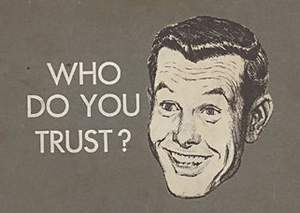
Then, I might start asking questions like, “Who can I trust?”
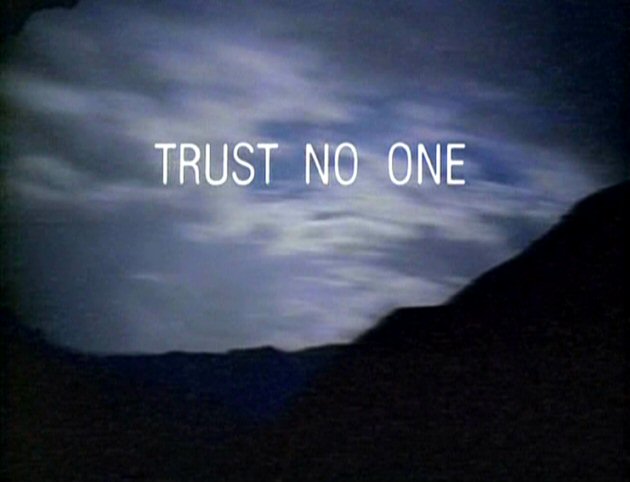
The answer might become extreme:
:
That’s not just a visual quote from the “X-Files.” It’s also some serious All-Or-Nothing Thinking (yep, another cognitive distortion):
All-or-Nothing thinking (also known as “Black-and-White thinking”).
Things are either all good or all bad, people are either perfect or failures, something new will either fix everything or be worthless. There is no middle ground; we place people and situations in “either/or” categories, with no shades of gray, or allowing for complexities. Watch out for absolute words like “always”, “never,” “totally,” etc. as indications of this kind of distortion.
It’s not helpful for me to think about trusting other people in all-or-nothing terms, or in any kind of extreme or rigid way.
It’s not helpful for me to be less trusting, just because selling IS everywhere. So what if most of the e-mails, snail mails, and messages surrounding me ARE trying to sell me something? That doesn’t have to seep into my general experience of connection in the world.
Sometimes, all the selling out there — and my fears about my ability to accurately see and negotiate that — can affect my experience of relationships. I can become hyper-aware of people’s self-interest, and even wonder how much room there is for anything else.
But focusing on self-interest in relationships is a distortion, too. Self-interest is there, of course. It has to be. But there is ALSO room for empathy, connection, and all the other human emotions and impulses that exist besides self-interest.
THE CLOSE*
So if I start to think that I am
naive
too trusting
in danger of being taken advantage of, or
in need of putting my guard up (including with people I know)
it’s time to back off on those All or Nothing thoughts about trust.
It’s also time to back off from labels like “naive.” Hey! I’m actually not naive. I may make mistakes. Who doesn’t? I’d have to be a mind reader to know people’s intentions, all the time. Labeling myself as “naive” or “too trusting” ignores and downplays my experience — what I’ve learned in negotiating interpersonal issues in the past.
And, really, I’ve done all right so far. I’ve managed to retain — in the face of all those people selling things out there — what I need, to keep going (like the computer I’m typing this post on, for example).
And if somebody does “rip me off” in some way in the future, I’ll learn from that and survive it, probably quite nicely.
All those things are helpful to remember. Very helpful.
THE CLOSE* (one more time)
So the answer to the question
is not an all-or-nothing one. It’s neither “everybody” nor “no one.”
Trust, like most things, can vary. I can choose how much I trust and whom, and adjust that based on new and changing information. And, I probably have more personal power in any interaction — involving $$$ or not — than I may think.
Ta da!
Thanks for reading (and for trusting, in some degree or another).
Years ago, I made up a “rule” for myself, to deal with my (human) tendency to focus on the negatives. If you’re like me in this way (and most people I meet seem to be), you automatically zero in on whatever isn’t “right” — possible sources of future trouble, critical comments, negative people, the “fly in the ointment,” mistakes, and so on.
As I’ve written in this blog before, this makes sense, purely from a survival standpoint. If there’s danger out there, it’s helpful for our bodies and minds to focus on that. If everything else is idyllic and safe, but there’s a potentially dangerous creature strolling by, that’s going to get all of our (and our ancient ancestors’) attention.
But this survival instinct can screw us up. It can cause us to over-emphasize the negative while dismissing the positive — reducing our joy, interfering with connections to others, and promoting worry and regret.
Several Cognitive Distortions (listed here), relate to that, including:
Negative filtering (also known as “Disqualifying the positive”).
This is when we focus on the negative, and filter out all positive aspects of a situation. For example, you get a good review at work with one critical comment, and the criticism becomes the focus, with the positive feedback fading or forgotten. You dismiss positives by explaining them away — for example, responding to a compliment with the thought, “They were just being nice.”
and
Magnifying or Minimizing.
We exaggerate the importance of some things (our mistakes, a critical reaction, somebody else’s achievements, things we haven’t done). Also, we inappropriately shrink the magnitude of other things (for example, our good qualities, compliments, what we have accomplished, or someone else’s imperfections).
and
Overgeneralization.
We come to a general conclusion based on a single incident or a single piece of evidence. If something bad happens only once, you expect it to happen over and over again. Example: seeing one incident of rejection as part of a never-ending pattern of defeat and failure.
So where’s the friggin’ rule, Ann?
Yes, I started out this post promising a rule I made up, to help deal with overemphasizing the negative. I put this rule in my list of remedies for cognitive distortions, and here it is:
The Equal Time Rule. To be fair, why not balance out the time spent on negative thoughts with positive thoughts? For example, if you spend a certain amount of time worrying or catastrophizing about something that then turns out okay, consider spending that much time feeling good about the outcome. Or, if you are focusing on a negative, critical person and worrying about how they might affect you, try to give equal time and power to a positive, supportive person.
Okay, time for an example!
Several posts this year have mentioned my dread of working on my income taxes (like here and here).
(I don’t know why I freak out, so much, about doing my taxes each year. I have a lot of self-knowledge and insight, or so I’m told, but I still don’t understand THAT, which I could probably explore in a ridiculously long post and/or another year of therapy). (But not now.)
Here is my yearly To Do List about taxes:
February 15. Start worrying about and dreading working on your taxes.Don’t actually do anything, but definitely beat yourself up about (1) procrastinating and (2) worrying so much about this, which is dopey and really getting old. Make sure you compare yourself to other people who have (1) completed their taxes and/or (2) aren’t as weird as you about worrying about this. Schedule a few weekends when you’re definitely going to work on this, but then don’t. Make sure to feel guilty about scheduling and then not following through. Try not to tell people how weird you are about this, but if you do tell people, make sure to feel dopey about that.
March 15. Continue doing all of the above, but more frequently and intensely. Note the amount of time you’ve wasted feeling bad about this and ask yourself questions like, “Why do you do this every year?” Decide that this year, you’ve gone further than you usually do in procrastinating; feel bad and somewhat panicky about that. Notice that the worrying about taxes is getting in the way of your anticipating the arrival of your favorite season — Spring! Feel REALLY bad about that.
The End of March: Always get done what you need to, somehow.
(Note that I’ve left something out here: my frequent uses of remedies and antidotes to help myself feel better during this process.) (Again, I’m overemphasizing the negative and minimizing the positive, in how I’m telling THIS story.) (Eeeek!)
THE PUNCHLINE
This year, I did the above routine again — as usual, starting around February 15.
AND, as usual, I finished the routine this past week. That is, I’m done with my preparation (and dread) about taxes for this year.
If I were to use my made-up Equal Time Rule, I would spend as much time and intensity feeling GOOD about completing my taxes as I did feeling bad about NOT doing them. That means I would spend more than a month, from now on, feeling relieved and great.
Will I do it? Nah. Not even close, people.
But I LOVE that idea. And by having that rule, even if I don’t keep it, I invite myself to feel as good as I possibly can for as long as I can possibly can.
After having resisted writing about this topic for 70 days, and returning to it yesterday, I am going to stay on it, for at least one more day.
One of the reasons I listed yesterday, of why feeling too good was scary, was this:
I’m afraid that I will be disappointed.
And sure enough, I was disappointed yesterday.
A client at the psychiatric day program where I used to work used to talk very eloquently about her fears about that fall from grace — the fall from feeling too good. She would sometimes make the argument that it wasn’t worth feeling too good, because the fall felt so bad.
And yesterday, I felt that drop very deeply, to the extent that I was affected all day. I felt bad. I felt shame.
But, what I’m realizing today, after I’ve slept on the experience (and spoken to several people on “my team”), is that the fall was something I constructed.
And what I mean by that is this: in my mind, I constructed the dimensions of the fall AND the meaning of it.
Here are the facts. The meeting I wrote about, in my post yesterday, was cancelled.
That is the data, pure and simple.
What I did, in my mind with that fact — that the meeting was cancelled — was all internal construction.
Boy, that’s noisy! I couldn’t turn that sound file off while I was writing this, and that felt annoying and somewhat disturbing.
But not as disturbing and painful as my internal constructions, yesterday:
Arrrgh! The meeting got cancelled. Of course. Here I thought I was important enough that somebody I respect so much and see at such a high level would actively want to meet with me. Obviously, I miscalculated. I’m not that important. I’m not seen as that important. Who did I think I was? And I wrote about the meeting in my blog! Arrrrgh! How humiliating. When I wrote that post, and left for the day, I felt so …. good, so full of myself — setting off for work, looking forward to that meeting. Hah! Well, I hope you learned your lesson. It’s not like you haven’t learned this before. You keep thinking you are more important, more valuable, better than you really are.
Ouch. And I felt shame, all day long. I tried to fight it, battling the distorted thinking with thoughts like these:
Come on! It’s just a cancellation. You’ll meet again. The person wrote you and told you they want to meet with you. Why not believe that e-mail? This is a familiar feeling. It’s shame. You talked about this yesterday with friends — how this is so inbred in you — the shame about feeling too good. This is an understandable and expected reaction, but that doesn’t mean your worst fears are true — that you need to beat yourself up all day.
And those thoughts helped, a little. But the shame remained.
I still got things done yesterday at work. I interacted with patients in a way that I think was authentic and maybe even somewhat helpful.
But when I got home from work, I said, “I had a bad day. I feel bad.”
And when I was asked the question, “What happened?” The answer was, “My meeting got cancelled.”
And those were the facts.
And today, I can see clearly again, and see that those are the facts. No more, no less.
But yesterday, I thought I was seeing clearly, too.
So that’s the dilemma. How can I monitor and interpret my importance? How can I figure out how much I matter, and how good I can feel about myself and still be safe?
Maybe the answer is this.
Maybe those are the wrong questions.
Maybe I can stop monitoring so closely. Maybe it’s not a matter of life or death for me to figure those things out.
Maybe I’ll just be disappointed some times. And maybe I’ll be delightfully surprised sometimes.
But no matter what, my essential worthiness does not fluctuate.
I woke up this morning feeling scared, and my natural preference for that was to isolate.
So I was choosing to write in my blog, rather than to talk to my boyfriend.
I noted that, and realized that it might be more helpful to connect with another person.
So I consciously chose to talk to him, briefly, before coming downstairs to write this blog post.
My wish this morning is to write this post before I leave for an 8:30 dentist appointment.
I know that what will help me to write this blog post quickly is to give this post a title like “Random Thoughts,” because that will quiet down my critical self, and allow me to just write, rather than judging and rewriting as I go.
I woke up pretty scared this morning, immediately aware of my hip pain, and my associated fear that I have endocarditis.
I wondered if this hip pain is “psychosomatic” — that there is actually nothing wrong with me.
I also have been worrying — now that I’ve blogged about this fear, sharing it with who knows how many people — that sharing this might have been a mistake.
Of course, it’s done, and I can’t undo that, and worrying about what is in the past does not help.
But that worrying has been very pervasive since I posted yesterday, so it might be helpful to look at that for a moment.
What seems to help me — when I’m scared — is to identify a link with my past, when I was a scared little girl in the hospital, dealing with heart problems and surgeries, alone without my parents for most of the time. (I write more about that experience, here.)
I had a pacemaker, starting at age 10, and because technology was so new, the pacemakers would break, a lot. The batteries would run down, the wires would break in various places, once the casing of the pacemaker — which wasn’t strong enough — “got permeated by my body fluids” (I swear I remember them using that exact phrase, when I was a kid).
It’s occurring to me now that my family and I, if we had been a litigious bunch, I suppose, could have sued about this stuff. Because, looking at it now, with the eyes of an adult, in a law-suit-permeated society, I guess we could have “made the case” that they were putting these pacemakers in a child before the pacemakers had been tested enough.
But this was at the dawn of pacemaker technology, and we didn’t have a choice. It was either use new pacemakers or lose me. At least, that was the story the doctors were telling, and i think that was a reasonable story at the time.
I remember my mother telling me the story of how the doctors broke the news to them that they had decided to put a pacemaker in me, at age 10. I had a heart stoppage during an observation visit at the hospital, which the doctors had never witnessed before. We think that my heart had stopped twice before, at that point, because I had fainted, once at home and once in the school yard. “Heart stopppages.” That term might not be accurate, right now, because in all three cases, my heart started up on its own again.
But the doctors still reacted very strongly when I fainted at the hospital, and they realized that my heart had stopped (and then started up again). They totally changed the game plan, and decided to put in a pacemaker the next day. My memories are that they had never even mentioned a pacemaker as a possibility before. (Or maybe they had mentioned it to my parents, who then kept that possibility from me. But I don’t think so.)
So after I fainted in the hospital (which I think was either on November 20th or 21st, 1963), the doctors decided to put in a pacemaker ASAP (which was on Friday, November 22).
That is a date which some readers will recognize immediately. November 22, 1963.
Anyway, I will say more about that in a future post.
So to return to my immediate goal this morning — I want to write a post that is helpful (for me) (and, therefore, perhaps for others) and reasonably coherent, by 7:15, which is 13 minutes from now.
So what is it that is most important for me to communicate this morning?
These random things:
When I am more scared than usual, there is usually an association with my past — when I was (apparently) a terrified little girl, alone in the hospital.
It helps me to name that. It helps remind me that I am NOT a scared little girl, alone in the hospital now.
I have skills I didn’t have then.
I have knowledge I didn’t have then.
I have connections I didn’t have then.
While I feel like I’m alone — while I feel like I have to withdraw from others in order to protect myself — I am not alone.
I think that’s what I needed to write this morning. I feel better now and ready to go out into the world, meet my obligations of the day, and bear my fears about my current medical condition.
However, I have seven more minutes!
So I’ll use the time to write down some other, less crucial random thoughts, dear reader.
Here they are:
When I use the term “dear reader” in my blog (even though both my son and my boyfriend don’t like that term), it’s my way of consciously trying to connect.
I’m good at connecting with people. I had to be, to survive as a little girl alone in the hospital.
I love that I’m good at connecting with people. It makes me good at my job, as a psychotherapist. It adds color and value to my life, every day, at work and everywhere else I go.
When I’m more scared, depressed, in worse mood, “more symptomatic” (whatever language I use for feeling worse), I tend to isolate.
And part of isolating is mind reading — projecting onto others my fears and judgments about my self.
One thing I’ve been doing since I blogged yesterday — which was a tough and important post for me to write — has been feeling some shame about sharing things that feel that personal — and medical — with people I know but also many, many people (even though I don’t know how many) that I don’t know.
It has been occurring to me a lot lately that blogging — sharing in the blogosphere — is very much like doing a therapy group. It evokes a lot of the same benefits — connecting and letting go of old habits and fears — as well as the same fears — have I said too much? will people judge me?
Sometimes I feel like a facilitator (group leader) when I’m doing this “Blogging Group”, and sometimes I’m more of a participant.
When I write about illness and fear, I feel like more of a participant.
Being a participant in a group is riskier than being a facilitator/group leader.
I have three more minutes!
It’s helping me to write down these thoughts.
There are lots of other things that I might write here, because I have lots of thoughts and have had a rich and complex past.
But what feels most important for me to say?
I guess I want to let you know that I have been projecting some old fears and hospital experiences on to you — my readers.
I’ve felt scared because I told you, yesterday, about my fears of having endocarditis. And that got me into a whole series of scary thoughts, which remind me of when I was a kid in the hospital, with a failing pacemaker.
Here are some thoughts that came up when I was a kid thinking something was wrong with me medically (that my pacemaker was failing), and which come up now (that I am afraid I have endocarditis):
Should I tell other people about this?
If I do tell other people about this — that I’m afraid that there is something wrong with my health — something that might be life-threatening — there are some risks.
I might be wrong. If I’m wrong and I got other people scared, I might lose them. They might get annoyed that I caused them unnecessary worry. I might lose credibility with them. “She’s the girl who cried ‘Wolf!’ We stopped listening to her!” And I did feel, when I was a kid, that I had to be right, 100% of the time, when I let people know I feared that my pacemaker was failing. If I was wrong one time, I believed THAT is what would stick — and they would never believe me again. But if I didn’t say something, I might die, because of a faulty pacemaker, which I was aware of, because my heart was skipping, but which was intermittently malfunctioning, so that the doctors could not replicate the problem at first. So i DID need to say something, But I might be wrong.
So being wrong was/is very scary.
I might be right. If I was right, I would need to have surgery (or — if I’m right about the endocarditis, I’ll need to leave work for a while and be on IV antibiotics for 6 weeks, and this will have been the fourth time, and last time, they said they might need to take some drastic measures, like extracting all my teeth) (NO!!!).
So being right was/is very scary.
Okay, I ran three minutes over. I think I can still get to my appointment on time.
I am not reading this over, at all, dear reader, before I post. I might, later, read this over and make some very basic corrections, if my fear is that I’ve lost you too badly. I want you to understand me!
I woke up early this morning, with the title of this post in my head.
And I understand why. Over the last couple of days, the few times I have felt bad, it’s been because I’ve believed that I have made …..
A MISTAKE.
(Imagine very, very scary music here) (perhaps written by Bernard Hermann, John Williams, or another film composer who has written very, very scary music.)
And I thought it was interesting that this particular title came up for me, because here is the original quote:
Oh, death, where art thou sting?
which is apparently from the bible. (I looked it up.)
So it’s interesting to me that the original quote was about death.
Because THAT’S how scary it can feel to me, when I make a mistake.
I will try to make this blog post short (although, probably, not quite as short as yesterday’s post), because I would like to go back to sleep. I WILL try to complete it in about 30 minutes, no matter what the length.
I would just like to mention Two Dread Mistakes I’ve made in the last two days, at which I (literally) went cold, when I realized what I had done:
Dread Mistake # 1
The day I got back to work, one of the other social workers at the hospital, named Tom, wrote an e-mail to all the other therapists there, asking if people could recommend a psychiatrist for a patient of his to see. There was a typo in his e-mail, so instead of “I am seeking a psychiatrist for a woman,” he wrote, “I am seeing a psychiatrist for a woman.” And I got a kick out of that, and wrote him an e-mail back, pointing that out to him.
In that e-mail I wrote him, I also told him that I loved that typo, and it helped me, because I always felt bad after I had sent an e-mail and realized that I had made a typo. So I told him he had made my day. And when I sent my e-mail, I specifically made sure to send it only to him, rather than press “Reply All.” I didn’t want to point out his mistake to everybody — that seemed snarky and ungenerous. I just wanted to communicate with him about it.
So, later that day, my supervisor at work told me that she had received my e-mail, too. And I couldn’t believe it. I figured that mistake was due to (1) all my Windows programs at work being updated a few days before I left, which has been confusing the hell out of me and (2) the fact that I was soooo exhausted my first day back at work.
And I felt AWFUL. And I knew my feeling that way was all out of proportion to the Sin that I Had Committed (which was negligible). But I just … could … not … shake … that …. feeling. And I tried, really hard, because my supervisor told me this right before we started conducting an interview with an intern, who is going to work with me next year.
Before and after the interview, my supervisor helped me deal with my … shame, I guess, about this mistake. She knows me well enough to have seen me struggle with mistakes. And, we actually told the intern we were interviewing (who was great, by the way) about how I was worrying about this dopey mistake I had made, and how my supervisor and I — and other therapists in the department — were learning how to deal with our own perfectionism.
So, after the interview, my supervisor and I discussed how I could feel better about this mistake I had made, of broadcasting my reply to Tom’s e-mail to dozens of other people. I called Tom and left him a message, letting him know how I had accidentally pressed “Reply All.”
And, he wrote me a very gracious, sweet, and funny e-mail back, telling me he liked my e-mail, that a lot of people had pointed out his mistake to him, and that it was all fine.
Dread Mistake #2
Hey! This one relates to my blog post, from yesterday. I wrote that post at 7 PM last night, when I was tired and hungry. I almost titled it “The 30-minute Blog,” because I wanted to “get it over with” quickly, so I could go out to dinner.
And I DID write that post in about 30 minutes, and I felt a feeling of satisfaction about that. And I thought the post was fine. So I was really glad when I pressed the “publish” button.
Then, at dinner, I checked the post briefly and realized …
(more scary film music, perhaps Bernard Hermann again, with shrieking violins, like from “Psycho”)
… that the post hadn’t really published, even though I had gotten the “You Published 43 Posts” message back from WordPress.
This has happened to me before. I think if I have two windows open while I’m writing, and I publish the post from the second window I’ve opened, it doesn’t work. Instead, it saves the draft.
So I KNEW that all I needed to do was to republish the post from the saved draft, when I got home. But I HATED that I had screwed up (with a computer, again! just like with Dread Mistake #1). I pictured people who follow my blog getting an e-mail (or seeing the post published on my Facebook page), clicking the link, and then receiving an error message about an empty post ( like what I saw when I checked at dinner).
And, again, I worked hard at letting go of the bad feeling, recognizing — rationally — that I was over-reacting. I realized that, honestly, who would care? This was no big deal and quite fixable, within an hour or so.
So, there are my confessions, about my two dread mistakes.
And I’m letting go of shame, right now, about how I can get so upset about such trivial mistakes.
And I’m working on this, dear reader, throughout this Year of Living Non-Judgmentally. I’m working on this, really hard.
And I’m definitely making progress.
You know, I wrote a chapter about Mistakes in the book I’m working on. (Possible title of that chapter: “Mistakes Won’t Kill You.”) And I talk to people about mistakes, in my work, a lot. And I know I’m not alone in beating myself up about mistakes.
I know I’ve written about mistakes in earlier blog posts here, but you know what? I’m not going to look at my past blog posts right now and provide some links.