Posts Tagged With: communication

Day 104: Things I know about groups

It’s time for a post that has a random collection of stuff I know!

This is my first attempt at a list — which I’ve often thought I should put together — of things that help people communicate more authentically in groups.

Because I am a group therapist (and I am giving presentations, these days, on the groups I’m doing), the focus of this list is from my perspective — a person who runs groups.  (However, I hope that you, dear reader,  might get something out of this, too.)

Things that Help People Communicate More Effectively (and More Authentically) In Groups

(and perhaps in any encounter with other people)

by Ann

  1. People know enough about what to expect from their experience in order to be present with less anxiety. This helpful knowledge includes each person’s role in the group, what is expected of them, and what might be coming next.
  2. People feel safe enough to disclose and share, which includes knowing that other people’s thoughts are not as dangerous as one might fear.
  3. Acknowledging and inviting all the different parts of each person  (including feelings and thoughts) (including the parts that are both accepted and disowned).
  4. Inviting what is shared and common among the group members (similar experiences, feelings, and thoughts).
  5. Acknowledgement of each person’s uniqueness — that they may feel alone and different at times. (This includes naming and validating this common thought, “I am the only one in this room who ……”)
  6. Link  # 5 above with #4, above, to focus on interpersonal connection. In other words, people are unique and may feel alone even while in the presence of others, but they are not alone with that, either!
  7. Inviting people’s needs.
  8. Leaving room for hope but also disappointment, because all personal needs will not be met during each encounter. (Group work is very much about balancing your needs with other people’s needs.)
  9. Leaving room for people to figure out how to continue the work beyond the group session,  including meeting those needs that weren’t met.
  10. Inviting everybody’s strengths and wisdom.

I focused on my needs  in writing this post today. I’m going to leave it with that emphasis, rather than work  much longer on this post, in order to make it more obviously useful to my readers.   I do want to finish this soon, and get out and enjoy the day.

But I do want to say this:

Blogging is another group interaction (at least it is, in my mind).  Considering that I focused more on my own needs in this post, I wonder how I did, in making this post effective for everybody who might read it? 

Oh, that reminds of something else I do in groups:

11.  Tell people there is no right or wrong way to do the group. Invite the concept of “good enough.”

I think I did a  good enough job balancing my needs  with your needs, today,  in this important personal interaction.

Oooops!   That reminds me of something else!

12.  Acknowledge the importance of the connection.

Okay, I’m done. For now.

Thanks for reading.

© 2013 Ann Koplow

Categories: personal growth | Tags: , , , , , , , , , , | 1 Comment

Day 81: An Appreciation Trip

I have the privilege of doing work that I truly love: being a group therapist.

As usual, in this moment, I am very conscious of language, as I attempt to communicate with others — out there in the blogosphere.

Here are some ways I can describe what I do. I lead groups. I facilitate groups. I do groups. I run groups.

My title? Group leader.  Group facilitator.  Group therapist.

None of this language completely captures what I do, and some of it seems misleading to me — giving me too much power, or otherwise not accurately reflecting my role and my experience in a group.

Digression about Language and Communication

I am focusing on language as I write this because language is sooooo important to me.  I really want to be understood. I really want to communicate, to another person, what is important to me.  I want to do that effectively, recognizing that there are so many reasons and ways that I might be misunderstood. There are so many barriers to people understanding each other.  I experience that every day — in my professional life and in my personal life.

Sometimes I say this when I’m talking about communication:  Each person is so unique — with a  history and a current experience that is so personal, so different from anybody else’s — that it’s amazing that we can understand each other, at all.  It’s like each one of us is our own country, with our own culture, language, and government.  No wonder there are misunderstandings — when two separate countries try to exchange with each other.

Now, I know that may sounds extreme.

And as usual, the opposite is true, too — sometimes when I communicate with others, or witness communication, I experience people understanding and connecting with each other in amazing ways — understanding each other so profoundly and unexpectedly, no matter what their differences. Then,  people can seem so connected,  it’s like we are almost one entity. (Not like The Borg, though.  Heaven forbid.)

Hmmm.  I was planning on writing about something simple, but instead, I seem to be trying to communicate Things Profound (and even Trippy).

End of Digression

When I lead or run or facilitate or do groups, I sometimes (if I’m lucky!) work with somebody else, often called a co-facilitator or co-leader.

For the groups I do on Thursday evenings, I’ve been lucky enough to have a co-facilitator this year.

But I work at a teaching hospital, so people who work there are often there for limited periods of time.   And it looks like my co-facilitator is leaving in a month or two.

Which I feel sad about, because I really enjoy working with her.

Last night, she couldn’t attend the group.

So this morning, I wrote her an e-mail, letting her know that I missed her last night and  that I’ll miss her if she leaves.

But I hesitated before writing it.

Why?

For several reasons:

  • It feels risky to let somebody know that I appreciate them.
  • It feels risky to let somebody know that I am sad, because I’ll miss them.
  • I’m afraid she might have some sort of adverse reaction, like guilt for missing last night’s group.

I recognize those feelings and fears, but my priority is  to let people know when I’m having a positive reaction to them (as I wrote about, here.) So I wrote the e-mail.  The subject for the e-mail was

An appreciation trip, not a guilt trip

And I let her know about how she was missed at group last night, as well as my feelings about the possibility of her leaving.

It felt like the next right thing to do. Or more simply, it felt right.  And as I wrote that e-mail subject, I thought, “That’s my topic for today’s blog.”

Which is now done.

Thanks for reading, everybody.

Categories: personal growth | Tags: , , , , , , , , , , | 4 Comments

Day 72: Short on words, long on gratitude

Hi, everybody.

I am feeling a lot of gratitude as I’m writing this post.

I’m grateful for my health.

I’m grateful for my family.

I’m grateful for my friends.

I’m grateful that I get to do work that I love and value.

I’m grateful that when I am kind to people, most people are kind back to me.

I’m grateful that there is something to learn no matter what the circumstances, even when the circumstances are painful (and I feel incapable of learning in the moment).

I am grateful for the privileges given to me by the accidents of where I was born and who I am.

I am grateful for all the different parts of my past, because they have contributed to who I am today.

I am grateful that I live in a time where I can connect with people in so many different ways.

I am grateful for you, dear reader.

Thanks.

Categories: personal growth | Tags: , , , , , , , , , | 5 Comments

Day 71: The Secret to Life is Three Things

Cristian Mihai is one of my favorite bloggers here.  This post of his showed up in my reader today.

That post, titled “Three easy steps to achieving what you want,” inspired me to write about something that I consider one of the most valuable gifts I’ve ever received.

About 20 years ago, I attended a weekend retreat — the  Opening the Heart Workshop — run by an organization which was then called “Spring Hill”.  (Spring Hill was a gorgeous location in Ashby, MA, and there are some pictures of that beautiful spot in the link above.)

During that weekend, one of the presenters told us this.

The secret to life is three things:

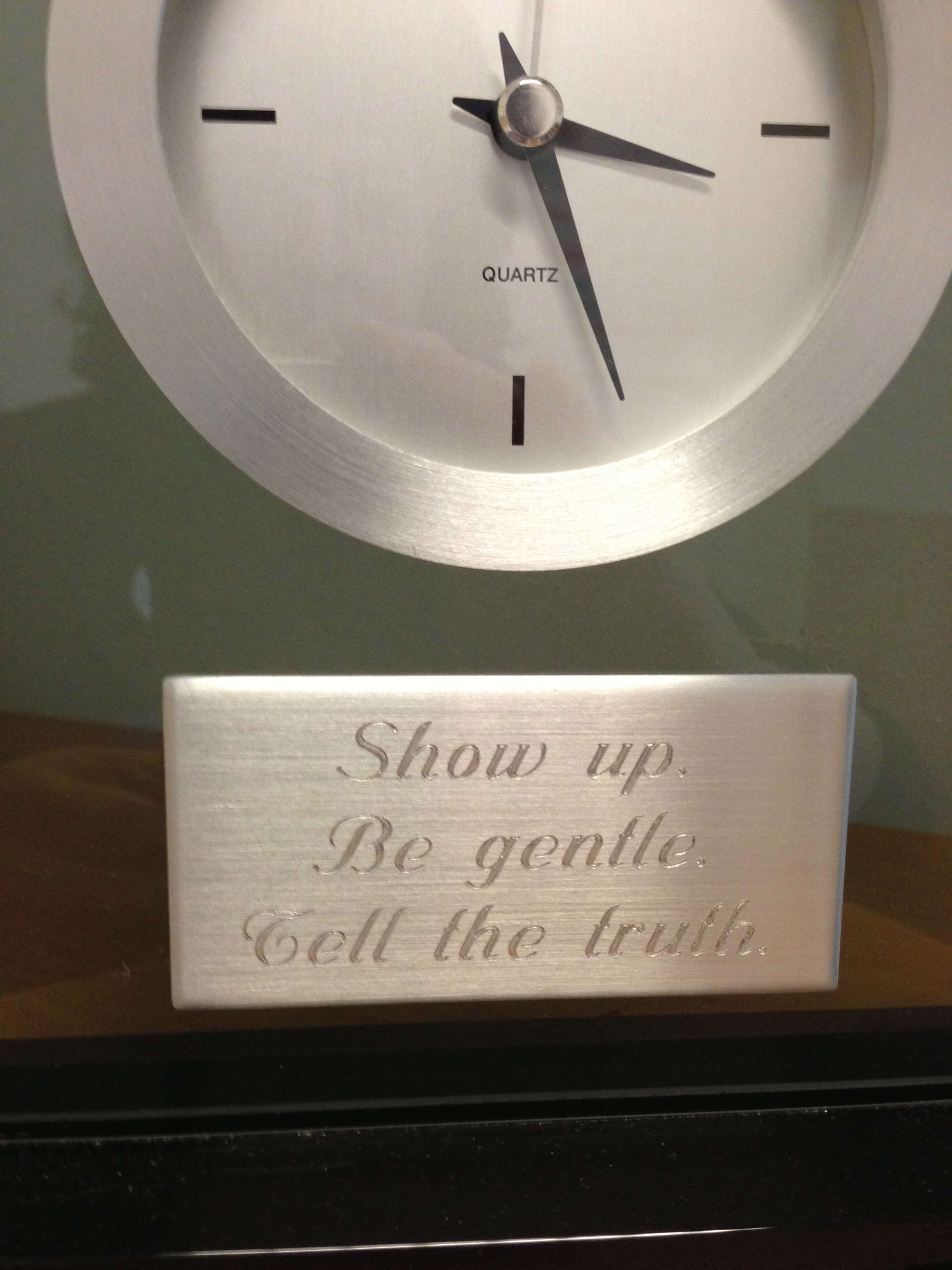
(1)  Show up.

(2)  Be gentle.

(3)  Tell the truth.

That’s it.

Since that weekend, I have shared that gift with many, many people.  I sometimes invite people to notice that “be gentle” also means to be gentle with yourself.

A lot of people have told me they find this gift really useful.

20 months ago, when I left the day treatment program where I’d worked for 12 years, one of my esteemed colleagues there gave me this clock as a going-away present:

IMG_0570

I keep this clock in my office.  I sometimes show this clock to people who come to therapy for the first time.  I think it’s a pretty good beginner’s How-To description of therapy.

So now that we’ve discussed the secret to life, I guess it’s time to end this blog post.


One more thing, though. When I got the photo of the clock off my phone, I noticed another photo I took recently, which is making me wonder if I should amend the title of this post.  

Maybe the secret of life also includes a fourth thing:


IMG_0565

(4) A bunny cake.

Thanks for reading, everybody.

Categories: personal growth | Tags: , , , , , , , , , , | 2 Comments

Day 69: To Do Lists (How NOT to get overwhelmed)

So!   I’ve been learning a lot lately about managing tasks and ideas, almost as quickly as this guy:

gary-lockwood

(For previous references to this Star Trek episode in this blog, see here and here.)

Here are some things I’ve been learning (and re-learning) about getting things done, without feeling overwhelmed.  (By the way, if you feel overwhelmed by the length of this list — or by all the links  in this post —  see #1, below.)

# 1. You don’t have to do everything immediately.

Often, you don’t even have to do anything immediately.

When I think of something I have to do, sometimes I act immediately for fear that I’ll forget it or I won’t do it.  And sometimes that immediate action is not only unnecessary, it’s not advisable.  (For example, lately I have been fighting the urge to record an idea or make a phone call on my cell phone while I’m driving.)

Have faith that if an idea is important, it will re-occur to you in the future. When you think of a task you need to do, even if it feels urgent, take a breath and allow yourself to ask a few questions about it — How urgent is this, really?  How should I prioritize it? When might I have time to do it well enough?

In general, have faith in your process. Try  telling yourself “I have all the time I need” (even if you don’t really believe it).

# 2. It can help to write things down.

To Do Lists for tasks and lists of ideas can be very helpful, especially for actions or ideas that (1) you can’t act on it on the moment or (2) you are likely to forget.

I have mixed feelings about To Do Lists.  They can help me remember things, but I’m concerned they might become Dreaded Lists of Shoulds and Proof To The Universe about What I’m Not Doing.

Also, I might lose a To Do List, and then spend precious time looking for the friggin’ thing.

However, I do have a big notebook at work where I write down my Really Important Things To Do, and that seems to work.  I’ve been trying to use my various electronic devices, too, as additional Ticklers, Reminders,  Updates, Notifications, etc. etc.  but haven’t quite mastered those options yet.

A Digression (and short Temper Tantrum) about Tasks and  Technology

There are SO many choices of how my cell phone, my lap top, and work computer can  remind me about stuff!!  Eeeek! That gets  overwhelming.  It’s like technology is getting better at helping us keep track of things at the same exact pace that technology is making us need to keep track of more things.

End of Digression

#3.  If there is an idea or a task that you CAN act on in the moment, consider doing it in the moment.

This may sound contradictory with #1 above, but there you go.

Letting go of shoulds and the anxiety about “I have to do this NOW!” can help you act in the here and now (and procrastinate less).

Here are some thoughts that can make it difficult to act in the moment:

  • This is important, so I have to do it well (or perfectly).
  • I don’t have enough time!! (Hint: there’s never enough time for perfection.)
  • There’s a chance for failure here, and that would make me feel worse.

To deal with paralyzing perfectionism, fears of failure, and too-much-to-do,  practice giving  yourself some slack.   Try doing something  that’s Good Enough, within a short period of time.  Making some progress will help (and you can always go back to it later).

#4.  Set limits with other people.

If other people are involved in the tasks you need to do,  it’s very helpful to set their expectations.  This can do wonders in reducing future anxiety — it’s like an anti-anxiety inoculation!

Here’s how it works.  When somebody is making a request of you (verbally or implied), respond with some version of this:

I can do this. I cannot do that.

An expanded version  of the above is:

I can do these things  (by this time).  I cannot do these things (unless I get more resources). 

You might worry that the person you are setting limits with will take offense at that.  If you are clear, direct, and specific, they will probably appreciate knowing this information.  And,  they will be more likely to leave you alone while you are getting things done!

You might not set limits or manage expectations perfectly. You might  promise something initially which you can’t meet. (I’m getting better at setting limits, but I tend to over-promise and under-estimate the time I need to do something.) If you over-promise or under-estimate,  let  the other person know as soon as possible,  thus reducing your future anxiety and guilt, as well their potential pissed-off-ed-ness. 

#5. Allow yourself the room to be “not perfect.”

You may think you need to be perfect, but nobody else expects that from you. (If somebody does expect perfectionism from others, they will be disappointed. If they don’t learn from that disappointment, they will be disappointed — and ineffective at dealing with people — their whole lives.)

You  don’t  have to get things right the first time — whether it’s managing expectations, writing, or anything else. You can recover from most “mistakes.”

Do you believe that?

Try believing it, and see what happens.

#6. Set limits with yourself.  

Give yourself a time limit to work on something. Limit the number of tasks you are going to try to accomplish.  

For example, I find it helps me to set a time limit on how long I spend writing my blog posts during the week days, and also limit myself to one blog post per day.

#7. Take care of yourself.

If you feel overwhelmed, take a break. Consider the possibility that you don’t HAVE to do anything right now. (I wrote a long post about that, here.)

If you are physically uncomfortable, change your position or adjust the heat.

If you need food, get yourself some (as soon as you can).

If you need sleep, get yourself some (as soon as you can).

#8.  Prioritize.

Recognize that you might have too much to do, and  choose one task to do next.

Let go of guilt and judgment about what you’re not doing. (I wrote more about that, here.)  

Notice and compensate for distorted priorities.

(Here’s some typical distorting prioritizing from me, which I’m doing less these days:

I need to do this NOW, because if I don’t, this person will be ANGRY, and I’m afraid of that person or I’m afraid I will lose that person.)

Where I work, everybody has too much to do, and that seems to be getting worse as time goes on.  People are coming up with creative ways to deal with this.

A  nurse I really like came into my office the other day to share how she manages having too much to do, without becoming overwhelmed.

One of the things she told me was, “I ask myself,  ‘Which is the task and which is the interruption?’  If I  can’t tell which is which, that means I’m overwhelmed. Then, I choose one and proceed with that one. And …. I cannot  choose incorrectly.”

I thought that was great.

#9. Recognize that there are some tasks you just don’t want to do.  

Allow yourself to have some sort of tantrum about that, if that would help.

 (I DON’T WANT TO WORK ON MY TAXES TODAY!!!!!! It’s not fair!!!)

(Better.)

Then, break that task into small steps and take the next one.

(First, I have to locate my documents. How about one document?  That seems do-able)

Consider giving yourself a reward for doing a task you don’t want to do. 

(I’m going to see the movie “Argo” at 4:30!!)

Also, try to reduce the pain of the actual process.

(Somebody at a group last week suggested working on taxes while listening to music you really love. I’ll listen to music on my headphones while looking for these friggin’ documents.)

Let go of cognitive distortions and the resulting guilt or shame about this:

( What’s the matter with me?  This shouldn’t be so hard!  I’m such a weird-o about doing taxes. Other people don’t have this problem. I probably shouldn’t even be writing about this in the blog. People are going to think I’m strange!  There is NO reason why I haven’t been able to get to this before today!)

(Hmmm. Actually, all of those statements above are false.)

(Better.)

#10.  Figure out short cuts and save them, for future easy access and use.  

Figure out short cuts that work for you, and try to make these short cuts easy- to-access, especially when you’re in the midst of being overwhelmed.

I’ve been trying to figure out short cuts at work lately, because I have way too much to do. (Like everybody else there.)  For example, I’ve been making templates of the notes I need to write,  giving myself prompts and choices for information I need to include. 

I’ve been trying to figure out short-cuts here, too, so I can blog more quickly and efficiently. For example, I looked for a short-cut, yesterday, for inserting a copyright symbol at the end of a blog post.

It’s even simpler than I expected. You can simply type a copyright symbol. On a Mac, it’s Option + G. 

#11. Let go of judgment about how you’re doing.

Tell yourself “I’m doing the best I can” in managing tasks and ideas (whether or not you believe it). Cut yourself some slack, especially if you’re doing something new (or something that feels new, because you haven’t done it enough times or recently enough to feel practiced).

#12. Be aware of your strengths and limits.  

Use your strengths whenever you can, and let go of judgment about your limits.

#13. Ask for help, especially regarding your limits.

This may be hard to do, but try this, please.

#14.  If  you are stuck, choose something easier to try.

If you are having trouble getting things done, choose one task that seems the most do-able in the moment.

#15. Consider editing your list. 

Change priorities and even delete things that just aren’t that important to get done.  Consider making things simpler.

#16. Pad your list, to give yourself a sense of accomplishment.  

Put things on your list that you’ve already started. Add  routine tasks. This will give you  a sense of accomplishment when you cross them off..

#17. Notice your resistance, letting go of judgment.

If you’re resisting doing something, assume that — on some level — that resistance makes sense. See if you can figure that out.  Even if you can’t, try to let go of judgment about the resistance.

Also resistance may mean that you don’t yet have what you need (data, support, completing something else first) in order to continue with your task.

Wow!  That list included a LOT of what I know, about a lot of things.

I wonder if there’s anything I have left to tell you  for the rest of this year?

Hmmm. Maybe I should do a To Do List about writing future blog posts.

  1. Start a list of ideas for future blog posts.  (Pssst!  I’ve already done that!)
  2. Keep adding to that list.
  3. Remember that I don’t have to come up with completely new topics.  I can keep writing about similar topics, in different ways (hence role-modeling the importance of “practice, practice, practice”).
  4. Consider spending the rest of the year posting more scenes from that Star Trek episode with Gary Lockwood.

That’s a good enough list, for now.

Thanks for reading.

© 2013 Ann Koplow

(Note:  I just want to let my  regular readers know that my test results came back and I do NOT have endocarditis. Yay!)

Categories: personal growth | Tags: , , , , , , , , , , | 28 Comments

Day 68: Barriers to Connection

This post is dedicated to my wonderful cousin, Lani, because the number 68 is very special to her.

Connection is super important to me.  And, while I only truly know my own experience, I’ve gotta believe that connection is also very important to most of you reading this.  (Data supporting this assumption:  If connecting with other people and their ideas was NOT important to you, why would you be reading this?)

I think a lot about connection — because of the work I do as a psychotherapist and because it makes life worthwhile for me.

Therefore, I also think a lot about the barriers to connection. What gets in the way of human beings connecting better with each other?

I will now make a list of possible candidates.

Barriers to Connection I Have Known

by Ann Koplow

Barrier #1.  My own insecurities.

This is probably the biggest barrier to my connecting in a more authentic, uncomplicated, and effective way to other people.  As a matter of fact, this might be a very short list. And a very short blog post.

Let’s see, do I have more to say about this?

Well, I could list my insecurities, which get in the way of connecting with other people.

Here are some of them:

  1. I’m not smart enough.  There are so many things that other people know that I don’t.
  2. I’m too smart, in some weird way, and people don’t understand what I’m trying to tell them.
  3. I’m just weird, because of my unique set of past experiences, so people don’t understand what I’m trying to tell them.

Okay.  Is there anything else I want to tell you about this, today, dear reader?

I guess not.

It looks like a beautiful day outside.  I’m going out there, people!

Thanks for reading.

Categories: personal growth | Tags: , , , , , , , , , , | 2 Comments

Day 64: You never know where your day is going to end up

This is going to be a short post because I had a very long day.

And all I want to say today is how my day started and how it ended.

My day started with my sobbing, before I left for work, because I had allowed myself to get in touch with some fears about my health, which I had never really allowed myself to feel before. These fears were a collection of old fears from my childhood and some current fears that I do need to live with, but often deny and suppress. And this morning, because I was talking about these fears to somebody I trust, I allowed myself to feel the fears in a new, very primal way.

And I sobbed.

Then I went to work and lots of things happened.

Then, tonight, I went to a meeting to start planning a high school reunion.  I traveled about 20 miles and about 45 years back in time, to meet with some people with whom I spent several formative years, but whom I have not seen for quite a while.  When I was traveling those 20 miles to the meeting — and because the memories of the past were right there — I had some fears about that meeting. I thought that perhaps these people at the meeting might have judged me in high school and might also judge me tonight.

(I mean, this may be the Year of Living Non-Judgmentally, but we’re talking High School, for cripe’s sake!)

But when I got to the meeting, I realized that everybody there wanted to be there because they felt an urge to reconnect.   And people were as kind as could be to me.

And I was happy to be there with them and to start planning our high school reunion, together.

So, dear reader, that was how my day started and how my day ended.

And I’m happy to be here, now, too.  Thanks for reading.

Categories: personal growth | Tags: , , , , , , , , , , , , | 4 Comments

Day 60: Why I’m not listening to the news these days

I used to listen to the news on the radio.

I’ve stopped.

The stories on the news are boring. They’re repetitive.They’re polarized into black and white, with no interesting grays.

The stories on the news have poor character development. People seem simple, reduced to quick definitions. Any shadings seem suspect and facile, provided by others with agendas.

The stories on the news focus on catastrophes. They predict the future and speculate what others are thinking. I hear blaming, all the time. And comparisons. Labeling. Shoulds.  Negative filtering. (The News: a festival of cognitive distortions.)

I can’t listen to news stories any more. I can’t bear the emptiness I find there.

The stories on the news seem arid and soulless, especially compared to the stories I am hearing people tell these days. I get to hear stories that are full-bodied, nuanced, and complex. I am riveted. I believe these stories. I care how they turn out.

The stories I’m choosing to witness these days speak to me of hope, not dread or emptiness.  Whether I encounter them in person or on the blogosphere, these stories are about expansion, not restriction.

I wonder if I’ll ever listen to the news again?

Thanks for reading this story, today.

Categories: personal growth | Tags: , , , , , , , , , | Leave a comment

Day 57: My Team (Position, Mechanic)

One of my favorite concepts from  Narrative Therapy is The Personal Team.  I love asking people questions about their team, like “Who is on your team?” “Is this person really on your team?”  “Who might you add to your team?”

The more conventional term for Personal Team is “support system,” defined by  Merriam-Webster as “a network of people who provide an individual with practical or emotional support.”

I am happy to report that I’ve got a great Mechanic on my team these days.  For a long time, I’ve believed that Mechanic is one of THE critical team positions (if you have a car).  (Another critical team position —  for me — is Hair Stylist, but that’s another topic.)

Here’s my Mechanic:

IMG_0507

This is Mark Jamieson. I first drove into his establishment — P & M Service Center, in Belmont —  about a year ago, looking for a new mechanic. When I first talked to Mark, my Trust Indicators all came up green.  And all my dealings with Mark and his service station have been consistently positive since.

Yesterday, after he did my yearly automobile inspection, I asked Mark if I could put him in this blog. He then told me some great stories, some of which I’ll include here.

When Mark was 12, he decided he wanted to start a business fixing lawn mowers, because he enjoyed doing mechanical things like that.  He asked his father (whom Mark describes as  “not mechanical at all”) to lend him $2 so he could advertise his lawn-mower repair abilities in the local paper.   And he got responses, really quickly.

Mark’s first customer — whom he remembers vividly —  asked Mark how much he would charge to fix his lawn mower. Mark, who hadn’t thought about money at all, took a wild guess and said, “50 cents?”  The customer replied, “No!  You have to charge more! You have to charge what your services are worth!” That customer suggested that Mark  charge $2, so he was able to pay his father back the loan immediately.

Very soon, lots of lawn mowers — and snow blowers, too — showed up on Mark’s front lawn. Mark fixed lots of lawn mowers and snow blowers  for a whole year (until his mother had had it with the mowers and blowers parked on the lawn).

When Mark was 19, on 12/1/1978, he bought the service establishment which is now P & M — where I happily bring my car.

As Mark told me stories about his work history, what kept coming through were lots of qualities I admire, including his continuing interest and pride in his work,  as well as an adherence to personal and professional values.

For example, Mark told me that he can tell, very quickly, when he meets a new customer, whether this is going to be a good match.  In Mark’s words, “everybody has to be comfortable.”  And if there isn’t that mutual comfort and satisfaction with the business relationship,  Mark says, “I don’t need everybody’s business.”  If it doesn’t work out, it doesn’t work out. (I told Mark I could relate to what he was saying.)

Before I left, Mark wanted to tell me this last story:

When Mark was  19 — his first year owning the service station — a new customer brought in a 1974 Ford Maverick. The Maverick owner told Mark that the car wouldn’t start and that it obviously needed a new starter. When Mark started to explain to this customer his usual plan — to check out the car and diagnose what was wrong with it — the guy got irate and said, “Hey!  I know what it needs!  The starter is broken!  Just do what I’m telling you and put in a new one!”   So Mark and his team put in a new starter, just as this guy had insisted. When this guy returned to pick up his car and tried to start the car, nothing happened.  The guy was very angry.  Mark told him, “Yes. It won’t start. That’s because you wouldn’t let us find out what was wrong with it  and fix it.”

I loved the way Mark told this story; I only hope I captured a flavor of how much fun he had telling me this.

Mark also told me yesterday, “I’m not a big Internet user”, but he knew that there was a website online where people shared opinions about service stations. He said, “We’ve won best service station for this area,”  which he hears about through new customers. And after I first met Mark, last year, I checked out my intuition about him and his service station on the internet and — indeed — the reviews were excellent.

Mark also has people working for him who are all helpful  and a pleasure to deal with. Here’s one of them:

IMG_0508

This is Tom. He helped me find my cell phone last week, with a lot of good humor.  (I had actually dropped it outside the service station, on a day when I was pretty sleep-deprived.)

Tom is more of an internet user than Mark, and he told me he’d be able to find this blog, easy.  Mark asked me to e-mail him the link so he could check it out. Actually, I’m going to drop by tomorrow, on my way to work, and show this post to Mark, to make sure I got the stories right. (I really value people’s stories and want to make sure I tell them correctly.)

Thanks for reading these stories today. And, dear reader,  I hope you have a good mechanic — and other good players — on your team.

Categories: personal growth | Tags: , , , , , , , , , , , | 17 Comments

Day 46: Words to Live By

I haven’t written much about how my 60th birthday party went down, way back on Groundhog Day (a.k.a Day 33) (a.k.a. February 2).

Planning that party did make an appearance in this blog,  on Day 16, when I was struggling with some self-judgment during that process.

My goal in planning that party was to create a day which was meaningful and fun, where people I appreciate and love could help me celebrate reaching  quite the birthday milestone.

One of my ideas was to put up on the wall giant post-it notes (these 25″ by 30″ beauties, right here), which people could write or draw on.  On some of those posters, I had written questions or topics that people could answer throughout the party. I  really liked that idea, because I thought that would help people engage and feel comfortable, soon after they entered the party, since the posters were hanging right where people first entered my place. Plus, in general, I LOVE asking people questions, so that made it more fun for ME.

Here were the questions I put up on the posters:

What is something in your life that you love?

What’s a really helpful lesson you’ve learned in your life?

Favorite movie?

Favorite song?

What makes a good party?

What’s something you haven’t done yet that you want to?

Words to live by?

If you could be any animal ….?

And during the party, it was fun for me to see my guests, engaging with each other around those questions. Plus, at the end of the party, I had — as a memento of the day — the answers to keep. All of the answers were anonymous, so that was fun, too — to guess who wrote what.

My idea for today’s blog was to pass on what people at my party wrote for “Words to Live By.”

This is what people wrote:

Disregard everything

Laugh a lot every day.

Laugh at lot at Ray every day. (This, I know, was written by my hilarious friend Janet, married to Ray.)

If not you, then who?

If not now, when?

Everything in moderation, including moderation.

Show up, be gentle, and tell the truth 

Please and thank you.

No, you first.

Leap and the net will appear.

Why not??

Don’t sweat the “small stuff” — it’s all “small stuff.”

Simplicity

Live, love, laugh

Do one thing every day that scares you. (Eleanor Roosevelt)

Life is emergent curriculum.

Those “Words to Live By” were just some of the many gifts I received at the party.

I’m pleased to re-gift them here, to you.

Categories: personal growth | Tags: , , , , , , , , , , | 6 Comments

Powered by WordPress.com.