
Posts Tagged With: Depression

Day 144: “Emergency” messages

I’ve often blogged here about cognitive distortions,including mind-reading, fortune-telling, comparisons, and negative filter. (Here’s a list of all thirteen cognitive distortions.)

I’ve also been working on a list of antidotes or remedies, to help break the habit of cognitive distortions.

Here’s the antidote I wanted to focus on, today:

The “In Case of Emergency, Break Glass” Technique. Prepare for the possibility that when you are feeling at your worst, coping strategies and solutions might be difficult to remember. Write down a couple of things that might be helpful to remember when you are feeling bad, and put that in a special place. Also, consider telling somebody else about these “emergency messages,” so they can remind you.

I’ve got my own message I would like to remember, in case of emergency. When I’m feeling down, depressed, hopeless, discouraged, self-critical, or self doubting, I wish I could remember this:  I will come through the bad time, with gifts I can use.

However, I can never remember that message, when I’m down. Never!  It’s like a spell is cast, that affects my memory.  When I’m feeling hopeless or powerless — because of disappointment or shame — my  belief is some form of this:

I suck and/or life sucks.

That’s what cognitive distortions do, in a nutshell. They present Sucky-ness of Self and Existence,  as The Truth.

But, it’s not The Truth. It’s just a belief, a thought, a temporary state of mind.

Each time, though, when I descend into a State of Ultimate Sucky-ness,  I simply cannot remember anything else. My Emergency Message is beyond me.

So, in order to try my “In Case of Emergency, Break Glass” antidote, I’ve been scoping out a special place to place my helpful Message to Self.

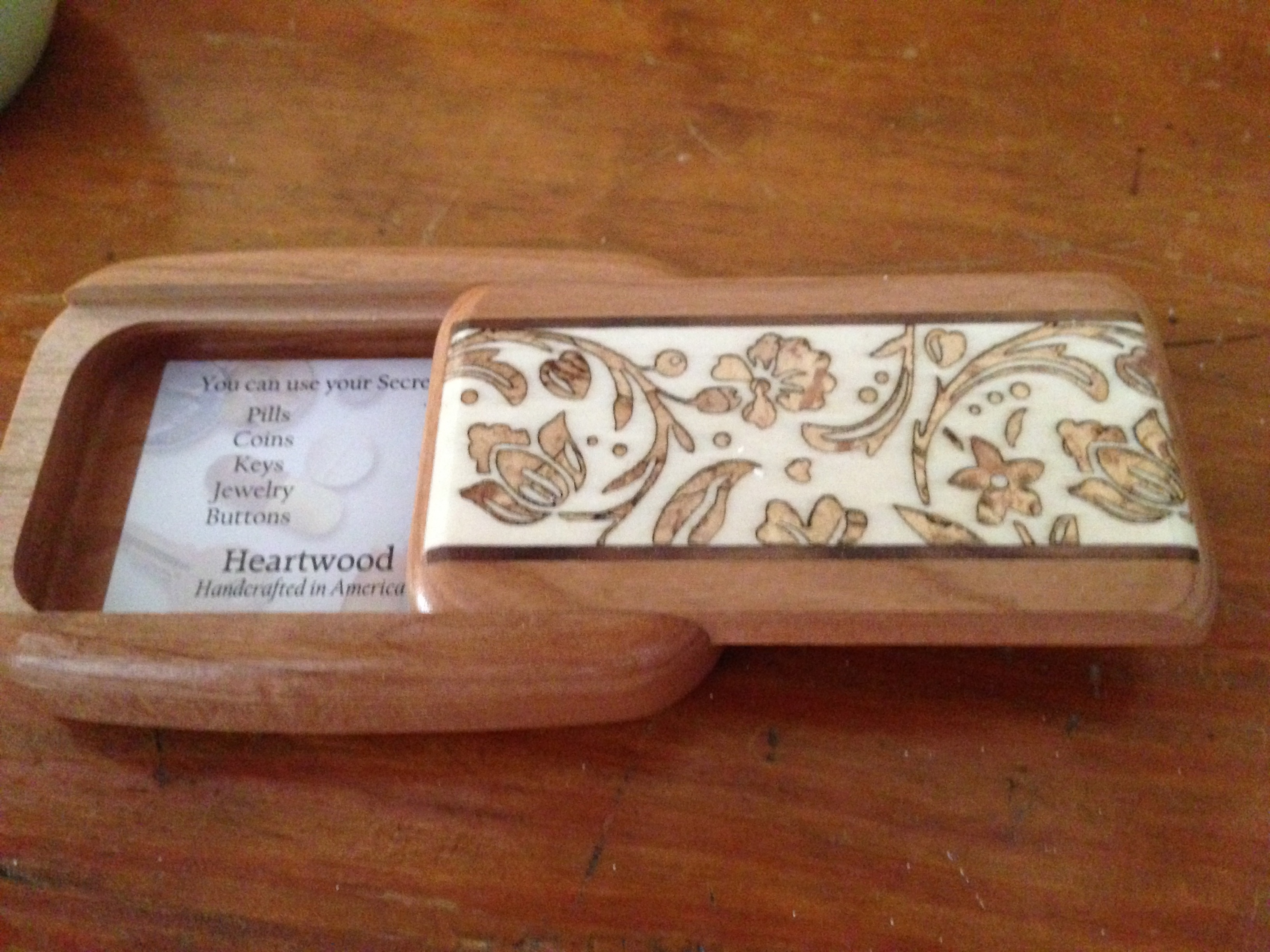
About a month ago, I got this box, with a hidden compartment. I thought I’d place my message there.
IMG_0904

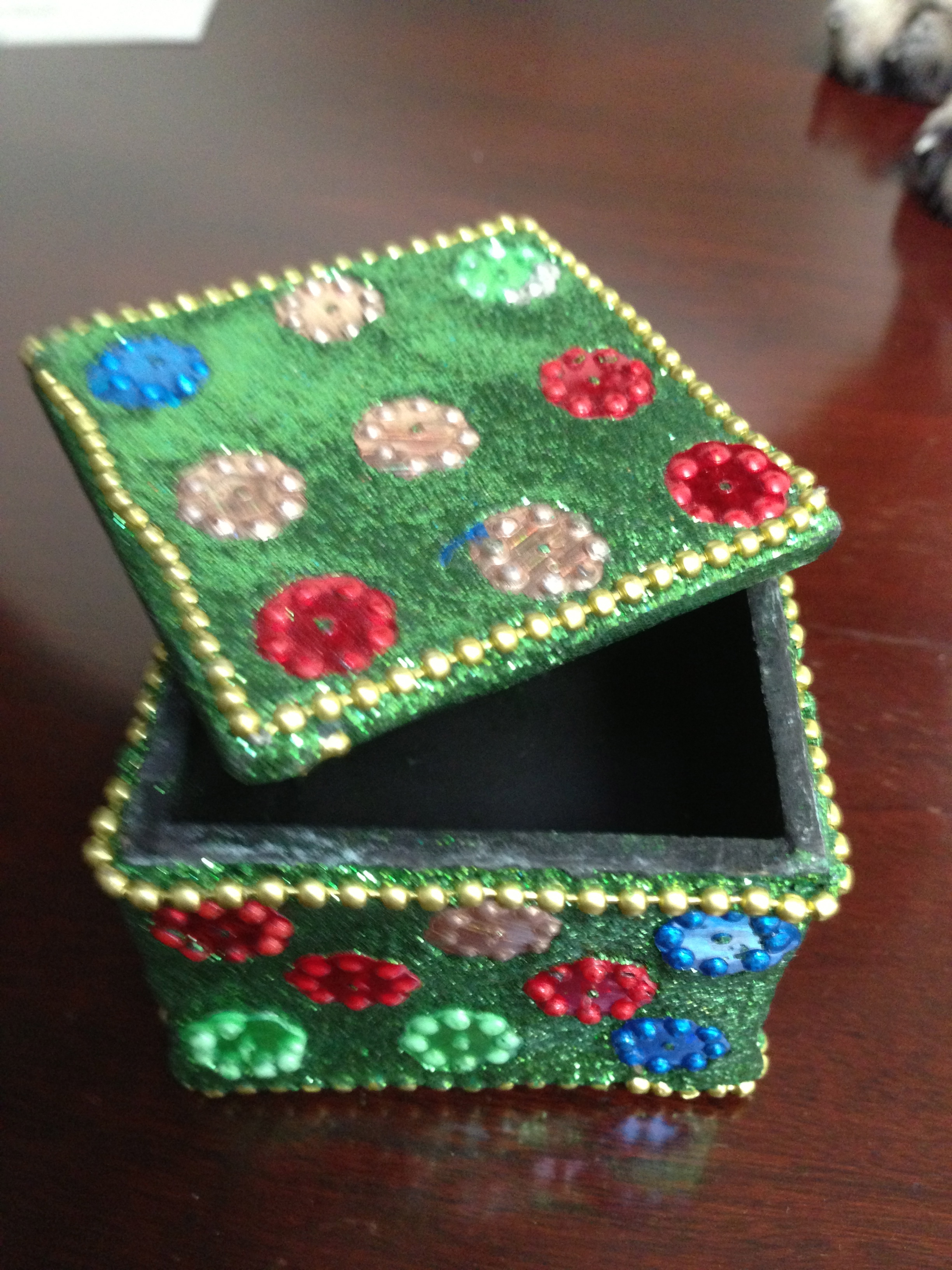
However, since I so easily lose sight of the message, I decided I needed a receptacle that was a lot less subtle.

So on my vacation, I bought this:
IMG_0897

That’s a lot harder to miss.

I’ve printed out this version of The Message:

When you are feeling, hopeless, powerless, selfish, foolish, disappointed or otherwise bad about yourself and your situation, remember this:

You will come out of this. And you will have ideas about ways to move forward.

I’ve placed that message in the box:
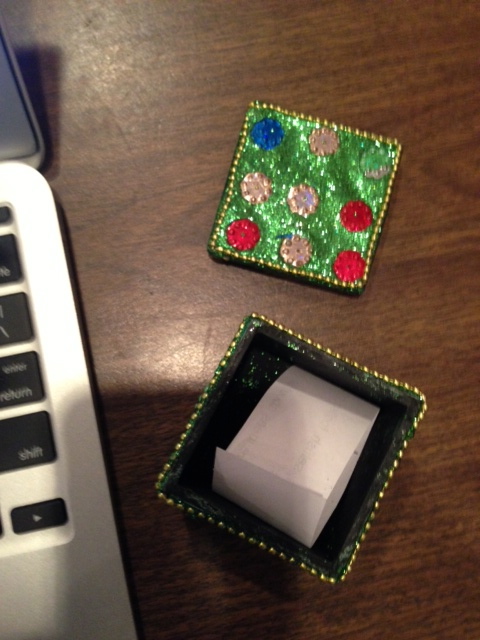
photo (52)

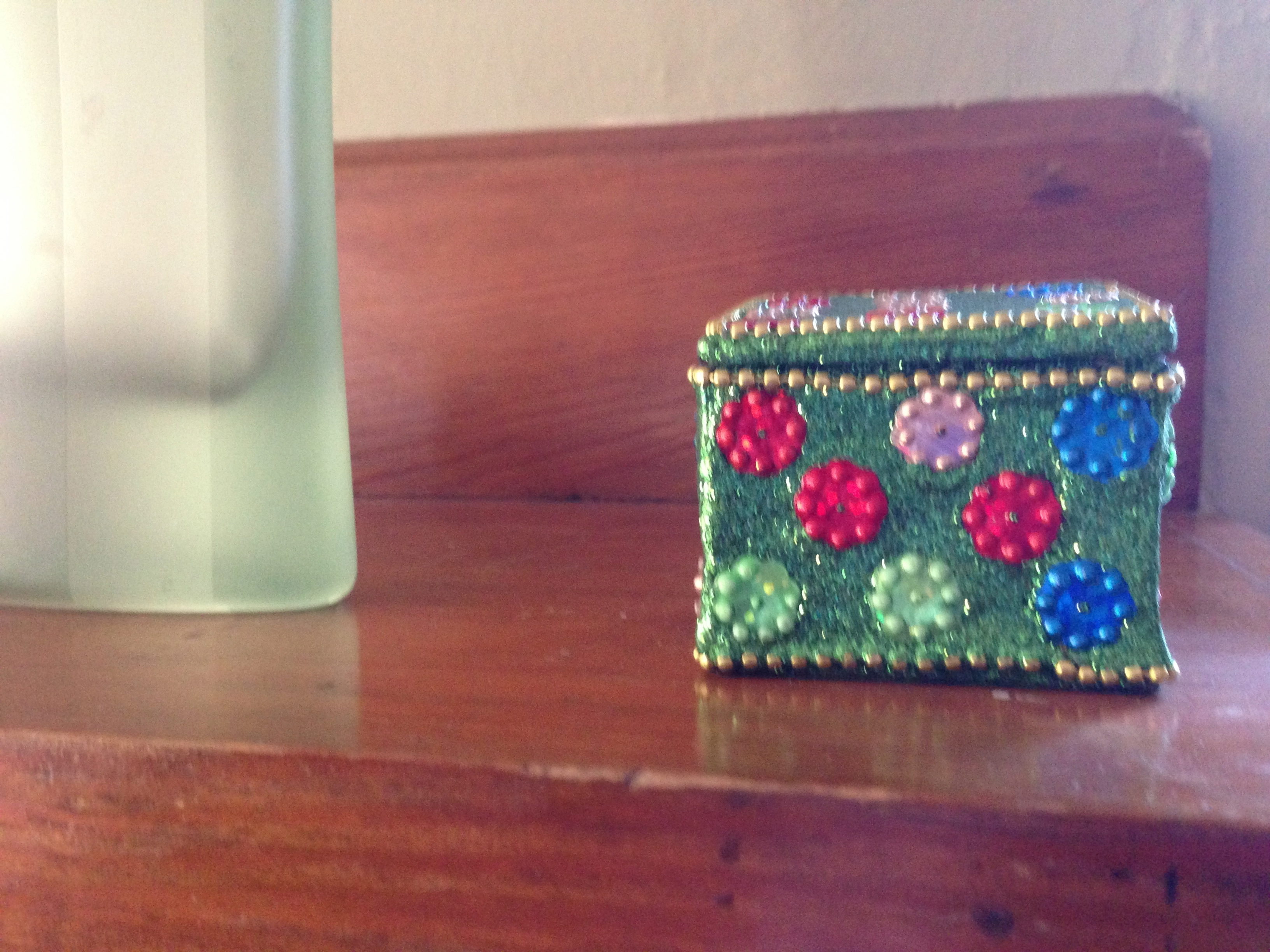
Now my box, with message inside, is sitting on the mantle:
IMG_0902

I hope I remember it’s there, the next time I need it.

I’ll keep you posted.

Thanks for reading, everybody. (And feel free to post what “emergency message” you might leave for yourself.)

Categories: personal growth | Tags: , , , , , , , , , , | 9 Comments

Day 91: The difference between arrogance and confidence

I am writing about this topic  because I dealt with somebody today, in a position of some power,  whom I  experienced as arrogant.  “Arrogant” was the adjective that occurred to me several times during the interactions I had with this person and the interactions I witnessed with other people.

And that had an effect on me, especially because I spent a lot of time in the hospital, as a child, dealing with all sorts of medical people, who were in positions of power.  I found it particularly challenging — and painful, at times — to deal with arrogance in that setting.

I will look up a definition of “arrogance” shortly, but first I want to say that my definition of arrogance definitely includes the following: a disinterest in listening to and learning from others.

I hesitated to write about this topic today, because I am, obviously, being judgmental here. To a certain extent, I am mind reading — assuming I know what is going on in the mind of somebody else.  How do I know whether somebody is disinterested in learning and listening, really?  I’m just guessing.

Here is an on-line definition of arrogance:

n.  offensive display of superiority or self-importance; overbearing pride; haughtiness.

Looking at that definition brings to mind something else.  I also hesitated to write about this topic today because I see so many people who are afraid of being arrogant — to the extent that they are afraid of being confident in themselves.

That concerns me. I often want to encourage people’s confidence and their belief in themselves. And it’s tricky, because how do we know if our pride and our sense of our own importance is “offensive” or “overbearing”?  Fear of being too confident often results in “playing small,” as described in the Marianne Williamson poem I included in a post, here.
.
I don’t know if this will help, but here’s another of my own personal definitions of arrogance:

.

If you are afraid of being arrogant, chances are you are not.

That’s a nice simple rule, isn’t it?

_____________________________

I also wanted to take this space to respond back to another blogger’s kind wish to connect with me and other bloggers by asking a series of questions.  And, as I’ve written before in this blog, I love questions! (See here for more about that, plus a tres cool special about Jackie Chan.)

Caliwow asked me to answer the questions she posed in this blog post.  I will now do my best to answer them authentically (while also sleazing out of answering some of them):

Q.  How old are you? *muwahahaha!*      

A. I  made it to 60!  

Q.  What is your favorite country and why?              

A.   I will pass on that question, because I don’t want to hurt any country’s feelings.

Q. If you could be any other race, which would it be and why?          

A.  See above for not wanting to hurt any feelings.

Q.  How do you make decisions?    

A.  Very reluctantly.  According to my Myers-Briggs test results, I have a high level of Perceiving (vs. Judging), which means I love collecting more and more data before actually making a decision.

Q. Share one moment in your life where you legitimately thought you were going to crash and burn; end up either losing all your friends, becoming homeless, have to move back in with your parents, etc…

A.  I’ve dealt with a couple of severe — although thankfully short-lived —  depressions in my life.  I definitely had some fear of “crashing and burning” during those.

Q. What are some of your top things to blog about?

A.  Questions and answers!!!

Q.  Who you pick from history to sit down and explain McDonald’s to?

A.  I have trouble explaining most things, much less McDonald’s.

Q.  Would you rather wake up naked and sore with no memory of the night before next to the Burger King telling you “you had it your way” or next to Ronald McDonald who told you how much you were “loving it”?

A. See above regarding my difficulty making decisions.

Q. Which TV show would you like to be a guest on?

A.  The Daily Show.

Q.  If you HAD to be a dangerous criminal from history in your next life, whom would you choose?

A.  I’m not coming back, if that’s my only choice.

Q. What type of utensil do you prefer while writing? Pen, pencil, marker, crayon, calligraphy brush, etc…

A.  Oh, man. Those were the good old days.  These days, I’m writing with a keyboard.  When I do use a utensil, it’s a pen.

Thanks, Calliewow, for including me in this question tag,  and for your inquisitive mind.

And thank YOU, for reading.

Categories: personal growth | Tags: , , , , , , , , | 4 Comments

Day 61: Accelerated Learning (Part 2)

Okay!  Here’s another in what might be a continuing series of things I’m learning this year — at such an accelerated pace, that I’m reminded of Gary Lockwood’s character in “Where No Man Has Gone Before” from Star Trek (The Original Series).

https://www.youtube.com/watch?v=2xeEDtF0bbE

Damn!  I still can’t find a clip that shows Gary’s character learning so rapidly that he speeds through pages he’s reading, really fast. (Although the clip which I ‘ve linked to, above, does show his rapidly acquired mastery of levitating a Cup of the Future, which is probably especially tricky.)

Since I can’t show you the clip I want right now, I’m searching for a good descriptive metaphor for how quickly that Star Trek character learns new things. Like wildfire?   Like Tom Cruise flying some jet in “Top Gun”? ( I’ve never seen “Top Gun”, but that still pops up when I’m trying to think of a metaphor for speed.)  Like some political party member talking to the media about things that are wrong with the other party?

No matter what the metaphor, here’s the deal, dear reader: (1) Gary Lockwood in Star Trek learns really quickly, (2) I’m learning lots of things (although not quite as quickly as him), and (3) you can read more about all that  (with a different clip from that Star Trek episode)  here.

Without further ado, here are more things that I’ve been learning lately, although not quite as rapidly as a Scary, Too-Smart-Becoming Guy on a 60’s TV show:

  1. Projecting fears and critical self-judgments onto other people really screws up a connection in the moment.
  2. Fears about other people’s reactions (anger, envy, fragility) can restrict you, big time.
  3. Worries about whether you’ll be able to sustain or hold on to a current situation, feeling, or thought can really get in the way of appreciating the current moment.
  4. Feeling depressed seems related to focusing on regrets about the past; being anxious seems related to focusing on fears about the future.
  5. It’s really difficult to calibrate and figure out How Important You Are to somebody else (or to a system or an organization).
  6. Taking any action related to How Important You Are can feel very risky, because of #5, above.
  7. You can often do a good enough job at a current task without access to more knowledge or the perfect tools (or the perfect clip from a TV show).
  8. If you don’t have the knowledge or tools to do a job that’s good enough, you can say so, and then find out what you need to complete the task.

That’s all, for now. I hope you enjoyed reading this so much, that it went by as quickly as (fill in your favorite metaphor for speed, here).

Categories: personal growth | Tags: , , , , , , , , , | 5 Comments

Day 17: I think I wake up most mornings feeling uneasy

I think when I first wake up, I have some sense of unease, some measure of worry and anxiety.

I can’t say for sure how long that’s been going on, because I seem to have a bad memory for certain things, especially feeling states.  I see that “bad memory” in other people, too, when I ask them, “How long have you been feeling this way?”  I can see people struggle to give me a good, accurate answer, and I reassure them that I just need a rough estimate. A ballpark figure.  Has it been days?  Has it been months?  Has it been years?  And that they can tell me.

(Okay I have a writer’s problem now.  I floated my topic sentence, and now I want to write more about this issue of emotional memory. I have a proposal, dear reader.  Stay with me on this detour, for a moment, and then I will guide us back to that promised topic.)

So, I think I’m noticing a pretty common human phenomenon there: no matter what emotional state people are in, they tend to remember the times when they felt the same way. When somebody is depressed, they tend to remember those times. The depressed periods are highlighted, and memories of joy, hope,  love, and other  mismatching emotions  fade. This selective memory can work for other feelings, too.  That is, when you’re happier and more secure, the sad times can recede in memory, too.  It’s like looking at your life with a certain search filter on.

(I think this selective emotional memory also relates to why, all my life, I’ve lived in a place that gets friggin’ freezing every winter.  I don’t like the cold. At all. And every winter, I say to myself, “Why do I stay here?  I hate this!  I deserve better than to be in this kind of pain, for this long, every year!  Life is too short, dammit! I am definitely going to look into moving (south, west, to Hawaii, etc.)!”  And every year, the beautiful, warming spring comes, and I forget about it.)

So (heading back around towards original topic!),  I don’t know how long I’ve been feeling this way, but I seem to wake up most mornings — at least, these days — feeling uneasy.  I suspect that this Initial Waking State is common for me, and has been going on for much of my life

And I guess that makes sense.  Why shouldn’t I wake up, ready for the day, with a sense of what needs to be attended to?  Wouldn’t that be an effective coping strategy for effectiveness, and maybe even survival?  If I wake up in a state of Zen and calm, maybe I won’t be as prepared to solve the problems, meet potential threats, avert possible calamities.

Screw it, though. I think waking up in a state of calm would be quite nice, don’t you?  And I’m sure I have woken up that way on certain mornings, but just not that often.

I will say this, though. As hazy as my emotional memories might be, I know that there have been times when I’ve woken up with a considerably higher level of discomfort and anxiety — more “on alert.”  Compared to those times, I am waking up kind of Zen-ish, actually.

I think I can do better, though. Let’s see how I’m waking up in April.  And November.

Categories: personal growth | Tags: , , , , , , , , , , , | 16 Comments

Day 11: You might as well be the hero of your own story.

(Note:  This post is an adaptation of another chapter for a potential book.)

(More important note:  If I ever refer in this blog to somebody I’ve worked with, I will have changed the name and any identifying details.)

In her first therapy session with me, a woman I’ll call Selena told me how she had stopped using crack cocaine 10 years ago, after years of addiction starting when she was only 14.

I could see Selena’s shame and regret as she told me how unavailable she had been to her children when they were young.  She also told me about her mother, who had raised her children for her. Her mother had been — and was still, the day of our meeting — very disappointed in Selena.  Selena said, “She always talks to me like I’m no good.”

 
As Selena told me her rich, complicated story, she looked weary and sad, and her language about herself was painfully judgmental. She was owning responsibility for the consequences of her choices, but she also seemed beaten and hopeless about the future. She seemed to agree with how her mother saw her. I waited for her to say something positive about herself — at least to show some pride about how she’d stopped using drugs on her own and had been sober for a decade. Also, I could hear that she was doing so much to repair the relationships with her grown children, and how that was going very well.

And she revealed so many admirable qualities in her first meeting with me, including empathy, humor, and creativity.  But when I asked her to name her positive qualities, which I do during every first session, she couldn’t name a thing. She said, “There’s nothing positive about me.” When I reflected back those positive qualities I had witnessed in her already, she didn’t buy it.  She said, “I’ve screwed up so many things in my life, how could I see myself those ways?”

While I wanted to respect where she was — and certainly not invalidate her experience —   I also wanted to invite her to see things a little differently. On impulse, I said to her,  “This is what I’m thinking, Selena.  Why not see yourself as the hero of  your own story? You might as well. It’s your story, for heaven’s sake.”  And we talked about stories in movies or books, where a hero could screw up, alienate people, and even make a total mess of things at times. But the hero was always the hero.

 
The way I invited Selena to be the hero of her own story is straight out of Narrative Therapy, one of my favorite ways of working with people. Narrative Therapy focuses on the stories we tell about ourselves, including how we describe and present ourselves as the protagonist — the main character of our story. There are so many different ways to tell ANY story, and as we tell the story of our lives to ourselves and others, we are constantly making choices. We are  picking and choosing different details and interpretations, as we make meaning of our complex lives and the parts we play.

I have to admit that, as I’ve told the story of my life to myself and others over the years, there have been times where I haven’t seen myself as The Hero of my own story. Instead, I’ve been the The Loser. Or The Villain.  Or The Victim. Or some unimportant cast member, like Girl in Crowd with Squint.

Not being the hero of your own story may very well be the hardest thing to endure. We can always, somehow, meet and move through anything — including pain, suffering, and tragedy. But not  if we’ve torn our best selves out of the picture, leaving behind a void — a powerless, scorned creature stripped of possibility.

My most unbearable experiences of this — of not being able to see myself as the hero of my own story — were two  clinical depressions, at ages 22 and 45. During both bouts of depression (each lasting about six months, though they seemed much, much longer), my critical self judgment went through the roof. I found it impossible to see myself as worthwhile in any way, much less the hero of anybody’s story.

Actually, when I was depressed, I rewrote the positive parts of my story up until then, to make them fit my new narrative conclusion — that I was a worthless, weird, and pathetic person. For example, I was pretty well liked in high school and got elected to class officer my freshman and senior years. When I got depressed at 22, I rewrote that story completely. I decided that I had been such an object of ridicule and dislike, that my classmates had voted me in as practical jokes, laughing at me all the while. ( By the way, I came up with that imaginative and dastardly plot device on my own, about the same time that Stephen King was using a similar motif in “Carrie”) (although in King’s version, the humiliation was real, not imagined, and pretty much everybody got killed).


When my clients concoct such false, negative stories about themselves, I often acknowledge and admire their creativity, but I also invite them to look at the consequences of their negative narrative choices, which can be so miserable and painful.

Think about the stories you tell about yourself, dear reader, and how you describe yourself as a “character” in those stories. Do you tend to tell certain types of stories about yourself?

And if you’re  accentuating the negative, could you tell those same stories differently?

Think about it. You might already be telling the story of yourself quite differently at different times — depending on your mood, your distance from the events, and  how you happen to be seeing and judging yourself (and life in general) in the moment of the telling.

Inviting somebody else in — to hear your story and to give you feedback — can often help you tell the same story quite differently.  Different people add very different  perspectives.  (See, for example, “Rashomon,” a movie built on just that.)  Some people have perspectives that might be helpful, while others won’t (like Selena’s mother).

How about you? What stories do you tend to tell about yourself and how do you present yourself as a character? If you tend to tell stories about screw ups and disappointments, how does that make you feel?  Compare that to how you feel when you tell stories showcasing your good qualities (or something you love, something you’ve accomplished, or somebody who is important to you).

In every negative story you might tell, there are the seeds of a thousand different ways to tell it, authentically and with more positive shadings.  This isn’t an Everything is Beautiful,  rainbows-and-unicorns claim on my part — it’s  always true. There’s no way to tell any story completely and perfectly, capturing all the complexities and nuances of all the characters and details involved. Therefore, every story we tell contains different tales with different conclusions, and we make choices at each point in the telling.

So, again, why not make yourself the hero of your own story?  I don’t mean a simplistic, perfectly good hero, but a complex hero who makes mistakes. A hero who feels not only “positive feelings” like  joy and optimism. but also “negative” ones like anger, fear, sadness, disappointment, and despair.

I hope, I hope, I hope  that you can see yourself as your own hero,  as much as you possibly can.   Because it HELPS, more than anything else I’ve ever seen.

© 2013 Ann Koplow

Categories: personal growth | Tags: , , , , , , , | 31 Comments

Powered by WordPress.com.