Posts Tagged With: cardiac pacemaker

Day 197: Technology, Part II

In yesterday’s post about technology and e-mail, there was a “shadow” — something on my mind, which I didn’t write about.

Here’s what it is: I’ve not only been having a complicated “relationship” with e-mail lately, but also with a different piece of technology.

My current cardiac pacemaker.

It’s time for a story …

Ann and Her Pacemakers

I got my first pacemaker when I was 10 years old, and I’ve had a LOT of them.

For the first 20 years or so, all the pacemakers I had were fixed-rate pacemakers. No matter what I did, how much I exerted myself, or what I was feeling, the pacemaker (and my heart) were beating the same amount of beats every minute: 80 beats per minute when I was a little kid and 70 when I got older. That meant I didn’t get the boost of extra beats for exercise.

That didn’t stop me from becoming a Disco Queen in the 1970’s, though.

Image

I (not pictured) took lots of disco lessons, danced in lots of places with lots of people, and had a blast. The way I dealt with fixed rate of my heart? I rested after a dance or two. Nobody knew the difference.

In the 1980’s, when I was in my 30’s, I got my first variable rate pacemaker. With this advance in technology, the pacemaker allowed my heart to speed up exactly when it needed to.

I remember, after I got my first variable rate pacemaker, going to an indoor athletic track, and jogging for the first time.

I felt like I was flying. It felt like a miracle.

Another part of the story is this: I have always been quite sensitive to how my heart is beating. In other words, if my heart skips or speeds up suddenly, I am very aware of it. I guess I’ve had to be, in order to survive. (Also, as somebody said to me when I was in my 20’s, “Ann, some people are just born sensitive.”)

Until I was in my 30’s and got the variable rate pacemaker, any variability in my heart beating (like missed beats, slowing down, or speeding up) meant that Something Was Wrong With The Pacemaker. And by being tuned in very acutely to my heartbeat, I pretty much always anticipated when my pacemaker was starting to fail.

You may have read, on this blog, my bragging about this: I am The Longest Surviving Person In The World With a Pacemaker.*

I’ve broken other records, too. Another one (I believe) is the Longest Lasting Single Pacemaker. That would have been the last pacemaker I had, before my current one. That Champ of a Pacemaker lasted just shy of 25 years. (This could be framed as “pay back” for all the pacemakers I had, early on, that broke and otherwise failed way too soon.)

I loved my last pacemaker, if I may use that emotional word about a piece of technology, because it not only kept me going, but it kept going for such a long time. And I felt physically great with it.

The current one, which I received about 17 months ago (but who’s counting?) does not seem to be quite as spectacular a match. With this pacemaker, my heart is skipping a lot of beats, speeding up suddenly, and … it just doesn’t feel as good. My doctors tried to adjust this latest pacemaker (the new ones have LOTS of fancy programming), but, at this point, we just can’t get it to stop those kinds of behaviors. It’s not that there is something wrong with it, it’s just picking up more than my other pacemakers. My doctors tell me that it is giving a more “accurate” representation of how my heart might naturally beat.

Perhaps this pacemaker is “too sensitive.”

(I wrote about the “too” word in a post, when I first started blogging, here. Also, “too sensitive” is something I hear people say about themselves, in a judgmental way. I sometimes think that’s a characterization that’s not particularly helpful.)

At this point, I’m not sure if anything further can be done, with this pacemaker, to make it a better fit for me and my needs. What I’ve done, for myself, to feel better, is to try to “disconnect” from my sensitivity to my own heartbeat. I’ve tried to “shut off” my immediate, familiar, and learned response of “There’s Something Wrong!” whenever my heart skips a lot.

But, my heartbeat has an effect on me. That effect may include anxiety, at times.

It’s so complicated, how all the different factors — internal and external — interact with each other.

How do I figure this out? And what to do?

Here’s what I thought of this morning.

The Serenity Prayer.

Again.

Grant me the serenity to accept the things I cannot change, the courage to change the things I can, and the wisdom to know the difference.

As usual, Part 3 — “the wisdom to know the difference” — is the challenging part.

What are the things I can and cannot change right now?

At this point, I don’t think I have more options to change this pacemaker, to make it a better fit, although I’m not sure about that. I could find out, perhaps. And, maybe I can find out more about my options for my next pacemaker.

In any case, it helps to name the situation, rather than avoiding it and trying to block it out. And, also, to identify an achievable next step or two.

Thanks, from the bottom of my heart (which skips sometimes), for visiting today.


  • I found out, in 2014, that this brag was not true.  See here for more about that.
Categories: personal growth | Tags: , , , , , , , | 12 Comments

Day 186: Watch out

I have a large collection of unusual and inexpensive watches. I started this collection over 35 years ago.

The collection got much larger when eBay came along — when it became much easier to find watches that fit my Collecting Criteria.

The number of watches I collected got a little scary. Actually, the number didn’t scare me, but I noticed that people had a reaction to that number — which looked a little like fear but might have just been surprise — when I would ask them to guess:

How many watches do you think I have?

People would always guess much lower than the actual number, even though I would explain — just as I did above — that I liked to collect these and that they were very accessible through eBay.

Collecting these watches definitely met some sort of need. I guess any kind of collecting behavior can seem like a compulsion. It didn’t feel like a compulsion; but I did spend a fair amount of time looking for watches, deciding about them, and adding new ones to my collection. It was fun.

Was it a habit? An addiction?

I’m reminded of a joke:

I may be addicted to drinking brake fluid, but I can stop at any time.

I kept collecting watches, for many years, growing my collection. And I did have Too Many watches to keep track of, to wear, and — especially — to keep supplied with fresh batteries.

But it was an enjoyable and harmless distraction, and I had some very cool watches. So I kept collecting.

Except one day, I stopped.

I stopped after I had a dream. In that dream, I was wearing a watch and the watch turned into a cardiac pacemaker.

And I woke up from that dream and said, “Duh.”

“Duh,” as in, “Wow. That makes a lot of sense.”

Here’s why:

I got my first cardiac pacemaker implanted when I was 10 years old. I had no choice over the matter. I will be dependent upon a pacemaker until I die. I have no control over all that.

I can tell the story of Ann and Her Pacemaker in lots of different ways.

Triumphant: I am the longest surviving person in the world with a pacemaker!*

Painful: I wasn’t prepared very well, before I got my first pacemaker at age 10. I spent a lot of time — some of it alone and scared — in the hospital.

The stories we tell can be a way of getting control over things.

Collecting watches was another way, for me.

Pacemakers and watches have a lot in common. They both are man-made devices that people wear. They are devices designed to measure and mark time, in an important way. As a matter of fact, all the pacemakers I got, until I was well into my 30’s, had a fixed rate. That is, they would produce the same number of beats per minute, every minute, until they ran down. The main difference between those pacemakers and a watch: my pacemakers were set for 70 beats for minute, instead of 60.

Anyway, once I realized WHY I was collecting watches — in a new and deeper way — I stopped needing to collect them. I’ve bought a watch or two since then, but very rarely.

I mean, I have enough watches, people.

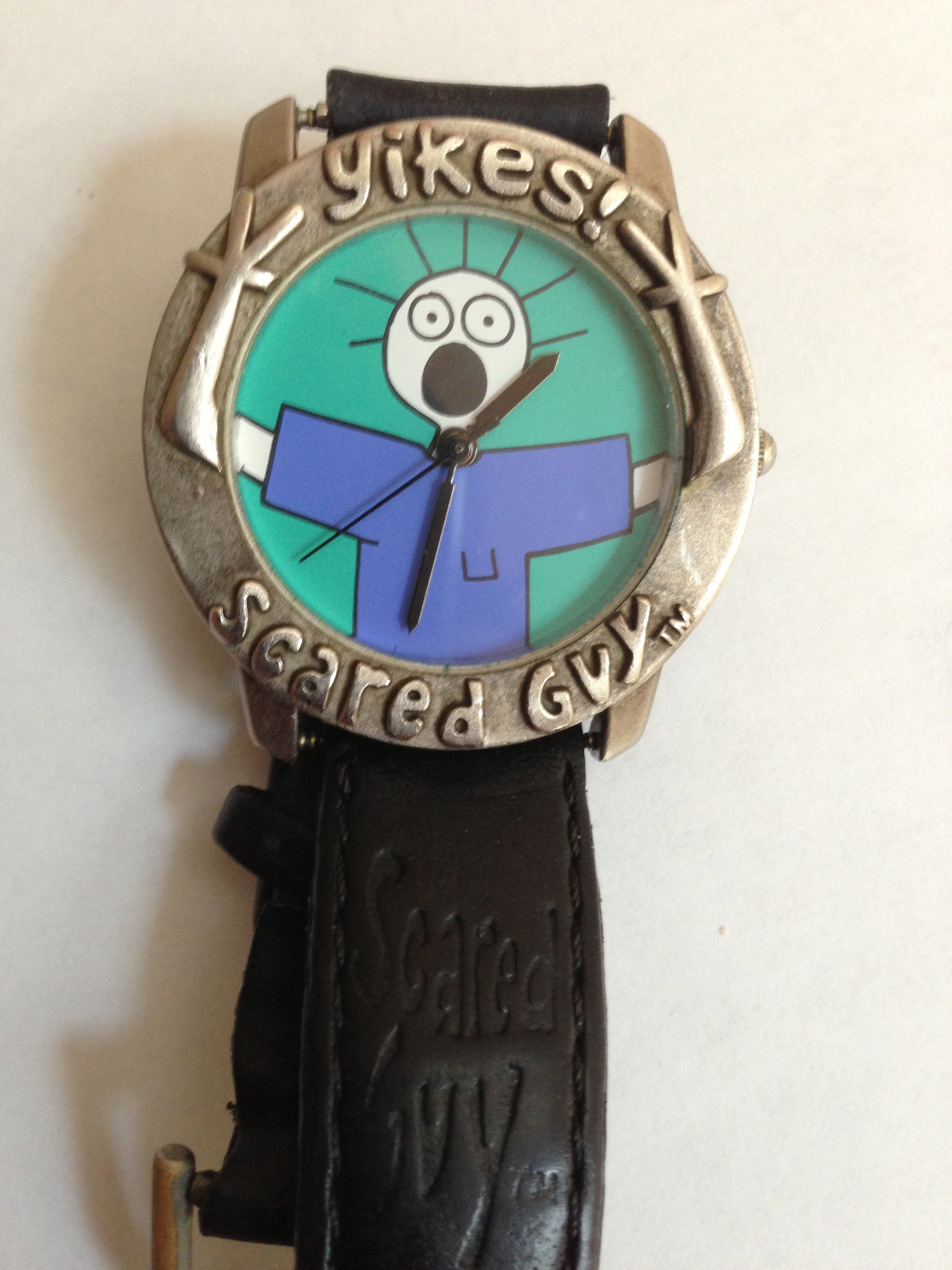
Before I end this post, I wanted to share one of my favorite watches with you:

Image

I got this watch on eBay, many years ago, when it came up in my saved search “unusual watches.”

This watch was developed by a woman who worked with kids who had cancer. In the eBay listing, she told the story of how she was working with a little boy who was having trouble expressing his fear of dealing with the diagnosis and the necessary procedures. On an impulse, she drew the picture of the character, whom she dubbed, “Scared Guy.” Scared Guy helped the little boy talk about his fear.

She later turned “Scared Guy” into a charitable enterprise, and she created and offered merchandise — including watches — using that character she drew for the little boy. The proceeds either went to supporting cancer research or other aspects of work with children who had cancer — I can’t remember, exactly.

I would give you more details about “Scared Guy ™” but I can’t find anything listed on the internet this morning. I do have the original watch box somewhere, which would tell me more, but I’m not looking for that right now.

I don’t have the time.

I have to get ready to go into the hospital, where I work.

And, I confess, I’m kind of a Scared Guy, today.

Why? There will be very few people around today, at the hospital where I work, because it’s the day after the July 4th holiday. I’m the only one there who has certain responsibilities. I may need to do some difficult and new things.

It’s a little too close, for comfort, to the old story I tell about my childhood, where I’m in a hospital, feeling alone, lost, and confused.

However, there are lots of differences today.

For one, I’ll be wearing that watch.

Thanks for being here, and reading, today.


* In 2014, I found out that I am NOT the longest surviving person in the world with a pacemaker.  See this post for more about that.

Categories: personal growth | Tags: , , , , , , , , , , | 40 Comments

Day 160: Fame, Shmame

Just to make sure that everybody who is reading this post understands the title, the second word — “Shmame” — is not a misspelling. There’s a tradition, in  American Jewish culture, to take a word (like “Fame”) and then reduce the power of the concept — in a humorous or ironic fashion — by putting a “shm” sound in the front of the word.

There’s a dismissive quality in the”shm,” for sure, which is highlighted in my two impeccable sources (found a few minutes ago, through Google, of course):

https://www.facebook.com/pages/Putting-shm-in-front-of-something-to-dismiss-it-as-rubbish/370038417939

and

http://forum.wordreference.com/showthread.php?t=688404

I especially like how — in that second link — somebody was searching for a definition for the word “shmoetry.”

By the way, I don’t know whether regular readers  have noticed this, but I like letting other people — on the internet, or anywhere —  do my work for me, especially when it comes to giving details or establishing credibility for any concept I feel like writing about.  That’s because I can get a little impatient with details.

In other words, details, shmetails.

Anyway, let’s get back to today’s concept which was ….

Fame.

Actually, let me take a step back and define fame this way:  as a function of attention.

Fame is attention, to the nth power.  Attention, on steroids.

And what is attention?

Attention is being seen, heard, recognized, and understood, for who we are.  We yearn for attention and often need it, to survive.

Who among us do not want to be seen, heard, recognized, and valued?  And the more we experience each other authentically (letting go of all those things that get in the way of understanding and being understood), the more connected — and the less isolated — we can be.

Many years ago, when I attended an Opening the Heart Workshop at Spring Hill, we worked on writing a personal, customized affirmation.

This is what I came up with:

I deserve to be seen, heard, and loved, exactly the way I am.

Now, as I’m including that affirmation in this post, I wonder about your reactions to it. Affirmations can seem hokey and clichéd, I know.  However,  that affirmation was really important to me, because — when I wrote it —  I didn’t BELIEVE that statement.  Like so many other people I’ve witnessed, I’ve often added too many qualifiers. Instead of that simple affirmation,  this is what I can believe, instead:

 I deserve to be seen, heard, and loved ONLY IF  (I do enough, don’t make mistakes, make a difference, have enough friends, look good enough,  etc.)

When I wrote that affirmation at the workshop, so many years ago,  it seemed so radical and weird. I’ve worked on believing it, ever since.  And, I’m happy to report that I do believe that affirmation more and more, as each year goes by.  (That’s one big reason I’m such a fan of aging.) (So far, anyway.)

So much for affirmations. Why did I start with FAME, on this beautiful morning?

Well, we live in a culture where fame is valued. And valuing fame makes sense, doesn’t it?  Fame is like hitting the Seen Heard  & Loved JACKPOT.

Also, I grew up in a family where certain celebrities were admired (including singers and comedians).  My father, who was a terrific singer and perhaps the funniest person I’ve ever met, might have felt a little frustrated in his chosen profession (as a pharmacist).  He was a born performer, and he was wonderful at it. While he had an outlet at social gatherings, at the synagogue, and basically everywhere he was, I got the sense he  was somewhat dissatisfied, that he wished he had a wider audience.

But maybe not.  I wish I could ask him, right now.

But I can’t.

So I guess I’m trying to figure out the meaning of fame —  for myself and perhaps in memory of my father, too.

These days (and I know I’ve written about this before, in this blog), I feel like that any yearning for fame can trip me up.  Using a Fame Measure can cause me to  judge and doubt the validity of what I’m doing. For example:  How many people will discover my blog?  How many people will discover the group work I’m doing?  How many people will know that I’ve lived with a cardiac pacemaker longer than anybody else in the world*?

But then I think:

Numbers, shmumbers.

And I ask myself these questions:

Do you love your work?

Check.

Are you getting a lot out of writing this blog?

Check.

No matter what your history is with pacemakers, is a pacemaker helping you live a full and healthy life, right now?

Check.

Okay, then!

Here are my concluding thoughts:

Past, schmast.  Future, shmuture.

In the moment, it’s all good.

Thanks for reading, shmeading, or whatever else you did here, today.


* In 2014, I found out this claim was NOT true. See here for more about that.)

Categories: personal growth | Tags: , , , , , , , , , | 6 Comments

Day 105: Everything makes sense on some level(s)

This seems like an important topic to me.

It really helps me to remember that everything makes sense on some level. (This seems to help other people, too.)

It’s something that I tend to forget, though.

It’s something that I keep re-learning, in new ways, as I grow.  (See this post, which people really seem to like, about re-learning things as we move through life.)

I want to start writing about this topic, in a new way, today.  I want to start telling the story differently.  (See this post, which people seem to like even more than the other one I just mentioned, about the importance of how we tell stories.)

I want to give myself room to write about this briefly — to start the conversation with you.  Because that’s another important lesson I’ve learned — it’s really valuable just to connect authentically, even for a few moments,  and start a conversation with somebody.

Really Brief Digression about the Presentation I Started Giving Last Week

At the end of the presentation I gave — called “The Power of Groups” (which is really about connecting effectively with patients, no matter where —  a medical resident put this beautifully. He said,  “What I learned today was that it’s a great start just to (1) validate a patient and (2) give them some next steps.”  (It made me so happy, that he (re-)learned that.)

End of Brief Digression

So, this is how I want to begin the conversation about this topic today.  I want to start listing things that freak me out — things that make me “too anxious,” and which can make me almost unbearably anxious when I’m under stress.

Today, I just want to name these things (thus reducing their power) and give a little bit of data about them, to start proving that they make sense on some level(s).

I am also going to divide the data into different types:  Reasons That I Share With Others (which help me feel connected to other people) and Reasons That Can Make Me Feel Different (and therefore alone).  This is something I notice all the time, in my work as a group therapist — people connect — and heal — when they realize they are not alone with feelings and experiences. At the same time, they can disconnect about things they feel alone about (and shame about).

Another thing I’ve been learning lately:  the things that make me feel alone and different might not be as isolating as I think.  So I’m going to address that in this list, too.

One More Digression (to stall and also — I hope — to be helpful)

Before I launch into this  list , which feels new, and therefore scary (see here for a fun post about that) (and yes, I am stalling — or “procrastinating” — by throwing in lots of links, because I’m anxious about writing this),  I just wanted to let you know that Naming Things and Gathering Data are #1 and #2 on  This List of Coping Strategies  — even if I don’t call them that on the list.

End of Last Digression

Okay!  Deep breath …..

Things That Freak Me Out “Too Much“

# 1 : Giving a presentation freaks me out.

Why this makes sense to most people:

The top two fears of people are public speaking and death.  (See this post for more about that, plus a quote from Jerry Seinfeld.)

Why this makes sense to (only) me:

Because, when I was in college, right before I graduated, the administration decided to give English Majors an Oral Exam (as a way to reduce grade inflation).  The board of professors who gave me that exam were very tough (I experienced them as shaming and humiliating).  I started out gamely, but things they said, (like “You are about to graduate from THIS SCHOOL and you don’t know THAT??”) made me so anxious, that I kept doing worse and worse.  I felt like I was freezing and my brain slowed down, and I remembered less and less. I left the room and burst into tears.  I knew I had screwed up.  When I told a friend how I had done, he said to me, “Oh, Ann. You always think you’ve screwed up.  I know one of the professors who was there. I’ll ask him.” And I remember my friend’s face when he said to me, “I spoke to him. You were right. You failed the exam.”  And I still graduated, with honors, but at  a (much) lower level.

Why that story of mine isn’t so different from lots of other stories:

Many people have had experiences of feeling humiliated while they were speaking in front of others.

#2:  When things don’t work the way I expect them to (especially technology), I freak out.

Why this makes sense to most people:

Lots of reasons: It’s frustrating when things don’t work the way they’re supposed to!  Most of us are trying to do too much with too little, and if things don’t work correctly, we feel like we don’t have time to spare to correct for that.   Some of us, who are older, feel like we can’t keep up with all the changes in technology (computers, cell phones, etc.). Even low-tech devices (like food processors, which freak me out) require a learning curve to use smoothly.

Why this makes sense to (only) me:

I am dependent upon a technological device — a cardiac pacemaker — to help me survive.  When man-made devices fail, that reminds me (on a subconscious level, usually) that my pacemaker can fail, too. (And I had several pacemakers that didn’t work so well , when both I and pacemaker technology were very young.)

Why this story of mine isn’t so different from lots of other stories:

Hmmm. I’m not sure about this one.  Maybe … lots of people feel REALLY dependent upon technology these days.

#3.  People not telling me the truth freaks me out.

Why this makes sense to most people:

Nobody likes being lied to. It can feel like a betrayal.

Why this makes sense to (only) me:

When  I was a kid in the hospital, and had gotten my first pacemaker, nobody prepared me for what it was going to look like in my body. (It was big and it stuck out under my skin, A LOT.) When I first saw it and asked what it was, a nurse — who was the only person there while I asked — lied to me about it.  She said it was just my hip, swollen from the surgery.  (By the way, this was the story that I didn’t feel ready to tell while I was writing this post.)

Why that story of mine isn’t so different from lots of other stories:

Lots of people have been lied to — when they were small, vulnerable, and powerless –  by those who were supposed to be taking care of them (and protecting them).

Oh.  I guess this is going to be a short list this morning.

It’s a beginning list, isn’t it?

And, you know what? I just told a story — that’s really important to me —  in a new way.  In a short way. In a contained way.  In a way to honor my difference and uniqueness, but also to connect with others.

And I feel better. I feel like I changed something here.

So that concludes our post for today, ladies and gentlemen.

I hope this post made sense (to you).  It made lots of sense to me.

Thank you, so much, for reading today.

Categories: personal growth | Tags: , , , , , , , , , , , , | 9 Comments

Day 66: Random Thoughts, before an 8:30 appointment

I woke up this morning feeling scared, and my natural preference for that was to isolate.

So I was choosing to write in my blog, rather than to talk to my boyfriend.

I noted that, and realized that it might be more helpful to connect with another person.

So I consciously chose to talk to him, briefly, before coming downstairs to write this blog post.

My wish this morning is to write this post before I leave for an 8:30 dentist appointment.

I know that what will help me to write this blog post quickly is to give this post a title like “Random Thoughts,” because that will quiet down my critical self, and allow me to just write, rather than judging and rewriting as I go.

I woke up pretty scared this morning, immediately aware of my hip pain, and my associated fear that I have endocarditis.

I wondered if this hip pain is “psychosomatic” — that there is actually nothing wrong with me.

I also have been worrying — now that I’ve blogged about this fear, sharing it with who knows how many people — that sharing this might have been a mistake.

Of course, it’s done, and I can’t undo that, and worrying about what is in the past does not help.

But that worrying has been very pervasive since I posted yesterday, so it might be helpful to look at that for a moment.

What seems to help me — when I’m scared — is to identify a link with my past, when I was a scared little girl in the hospital, dealing with heart problems and surgeries, alone without my parents for most of the time. (I write more about that experience, here.)

I had a pacemaker, starting at age 10, and because technology was so new, the pacemakers would break, a lot. The batteries would run down, the wires would break in various places, once the casing of the pacemaker — which wasn’t strong enough — “got permeated by my body fluids” (I swear I remember them using that exact phrase, when I was a kid).

It’s occurring to me now that my family and I, if we had been a litigious bunch, I suppose, could have sued about this stuff. Because, looking at it now, with the eyes of an adult, in a law-suit-permeated society, I guess we could have “made the case” that they were putting these pacemakers in a child before the pacemakers had been tested enough.

But this was at the dawn of pacemaker technology, and we didn’t have a choice. It was either use new pacemakers or lose me. At least, that was the story the doctors were telling, and i think that was a reasonable story at the time.

I remember my mother telling me the story of how the doctors broke the news to them that they had decided to put a pacemaker in me, at age 10. I had a heart stoppage during an observation visit at the hospital, which the doctors had never witnessed before. We think that my heart had stopped twice before, at that point, because I had fainted, once at home and once in the school yard. “Heart stopppages.” That term might not be accurate, right now, because in all three cases, my heart started up on its own again.

But the doctors still reacted very strongly when I fainted at the hospital, and they realized that my heart had stopped (and then started up again). They totally changed the game plan, and decided to put in a pacemaker the next day. My memories are that they had never even mentioned a pacemaker as a possibility before. (Or maybe they had mentioned it to my parents, who then kept that possibility from me. But I don’t think so.)

So after I fainted in the hospital (which I think was either on November 20th or 21st, 1963), the doctors decided to put in a pacemaker ASAP (which was on Friday, November 22).

That is a date which some readers will recognize immediately. November 22, 1963.

Anyway, I will say more about that in a future post.

So to return to my immediate goal this morning — I want to write a post that is helpful (for me) (and, therefore, perhaps for others) and reasonably coherent, by 7:15, which is 13 minutes from now.

So what is it that is most important for me to communicate this morning?

These random things:

When I am more scared than usual, there is usually an association with my past — when I was (apparently) a terrified little girl, alone in the hospital.

It helps me to name that. It helps remind me that I am NOT a scared little girl, alone in the hospital now.

I have skills I didn’t have then.

I have knowledge I didn’t have then.

I have connections I didn’t have then.

While I feel like I’m alone — while I feel like I have to withdraw from others in order to protect myself — I am not alone.

I think that’s what I needed to write this morning. I feel better now and ready to go out into the world, meet my obligations of the day, and bear my fears about my current medical condition.

However, I have seven more minutes!

So I’ll use the time to write down some other, less crucial random thoughts, dear reader.

Here they are:

When I use the term “dear reader” in my blog (even though both my son and my boyfriend don’t like that term), it’s my way of consciously trying to connect.

I’m good at connecting with people. I had to be, to survive as a little girl alone in the hospital.

I love that I’m good at connecting with people. It makes me good at my job, as a psychotherapist. It adds color and value to my life, every day, at work and everywhere else I go.

When I’m more scared, depressed, in worse mood, “more symptomatic” (whatever language I use for feeling worse), I tend to isolate.

And part of isolating is mind reading — projecting onto others my fears and judgments about my self.

One thing I’ve been doing since I blogged yesterday — which was a tough and important post for me to write — has been feeling some shame about sharing things that feel that personal — and medical — with people I know but also many, many people (even though I don’t know how many) that I don’t know.

It has been occurring to me a lot lately that blogging — sharing in the blogosphere — is very much like doing a therapy group. It evokes a lot of the same benefits — connecting and letting go of old habits and fears — as well as the same fears — have I said too much? will people judge me?

Sometimes I feel like a facilitator (group leader) when I’m doing this “Blogging Group”, and sometimes I’m more of a participant.

When I write about illness and fear, I feel like more of a participant.

Being a participant in a group is riskier than being a facilitator/group leader.

I have three more minutes!

It’s helping me to write down these thoughts.

There are lots of other things that I might write here, because I have lots of thoughts and have had a rich and complex past.

But what feels most important for me to say?

I guess I want to let you know that I have been projecting some old fears and hospital experiences on to you — my readers.

I’ve felt scared because I told you, yesterday, about my fears of having endocarditis. And that got me into a whole series of scary thoughts, which remind me of when I was a kid in the hospital, with a failing pacemaker.

Here are some thoughts that came up when I was a kid thinking something was wrong with me medically (that my pacemaker was failing), and which come up now (that I am afraid I have endocarditis):

Should I tell other people about this?

If I do tell other people about this — that I’m afraid that there is something wrong with my health — something that might be life-threatening — there are some risks.

I might be wrong. If I’m wrong and I got other people scared, I might lose them. They might get annoyed that I caused them unnecessary worry. I might lose credibility with them. “She’s the girl who cried ‘Wolf!’ We stopped listening to her!” And I did feel, when I was a kid, that I had to be right, 100% of the time, when I let people know I feared that my pacemaker was failing. If I was wrong one time, I believed THAT is what would stick — and they would never believe me again. But if I didn’t say something, I might die, because of a faulty pacemaker, which I was aware of, because my heart was skipping, but which was intermittently malfunctioning, so that the doctors could not replicate the problem at first. So i DID need to say something, But I might be wrong.

So being wrong was/is very scary.

I might be right. If I was right, I would need to have surgery (or — if I’m right about the endocarditis, I’ll need to leave work for a while and be on IV antibiotics for 6 weeks, and this will have been the fourth time, and last time, they said they might need to take some drastic measures, like extracting all my teeth) (NO!!!).

So being right was/is very scary.

Okay, I ran three minutes over. I think I can still get to my appointment on time.

I am not reading this over, at all, dear reader, before I post. I might, later, read this over and make some very basic corrections, if my fear is that I’ve lost you too badly. I want you to understand me!

Okay, now I’m done.

One more thing, of course: thanks for reading.

Categories: personal growth | Tags: , , , , , , , , , , | 15 Comments

Day 6: The Ascending Coil

Note: Today’s blog entry is an adaptation of the intro from one of the books I’m working on. Also, it’s the first time I’ve tried to use an illustration in a post!

In my work as an individual and group therapist, there’s an image I like to use when someone is discouraged about a personal setback. A client might say, “I thought I was making progress, but now I’m back to square one.” Or “I was feeling so much better, and then I started feeling bad again. What’s wrong with me?” Or “I’ve already learned this! Why do I keep making the same mistakes?”

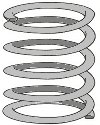
When I hear people say these things, I often draw a spiral or coil that looks something like this:

(Honestly, what I draw might be sloppier than that, but it does a better job implying onward and upward movement.  But, hey!  the above is the best  coil  I’ve been able to find online, so far.)

I tell people this image is based on the work of Carl Jung, who described the ascending coil as the typical way that people grow, learn, and develop through life. Jung said that people keep going over similar territory, encountering similar issues along their way. And those circles can feel like we’re stuck in a pattern, going through the same damn thing over and over again.

However, notice that every time we circle around, we’re also in a different place. Jung said that the same time we’re going around, we’re also simultaneously moving up and ahead. Each time we come around, we’re further along, with experiences and knowledge we didn’t have before. Therefore,  we can never go over the same exact territory the same way. It’s impossible. We simply cannot  fall back to square one (or square anything). We may be re-visiting similar territory, but we’re different,  and we’re doing it differently every time.

I’ve drawn and shown this ascending coil  to many people over the years. When I talk to people about it for the first time, I often see reactions that look similar to how I felt when it was first shown to me. When I first saw and thoughts about that coil,  I felt recognition. I felt relief. I realized that I was not alone in struggling with (and often judging) my progress through life.  And, best of all,  I felt a reassuring acceptance about where I’d been, where I was, and where I might be going.

Each of us has our own ascending mortal coil, our own path of learning and growth.  For most of us, the  early, crucial go-rounds included some difficult passages.  Perhaps we encountered some unexpected calamities, too early. Perhaps we didn’t get some things we really needed. Perhaps we lost track of our basic worthiness.  Not surprisingly, those early go-rounds tend to influence and shape what territories and lessons we re-encounter  as we move upward.

For me, those early, formative passages included my being born with an unusual heart, which resulted in my being hospitalized a lot when I was a kid, and my needing a cardiac pacemaker when both I and pacemaker technology were quite young.  (Bragging point: I am the longest surviving person with a pacemaker, in the world.) (Yes, I am.)*

A lot of those early hospital experiences have lingered for me in challenging ways — making hospitals places I’ve tended to avoid, whenever I’ve had that choice. Yet, I have recently chosen to return to the hospital in a different way:  as a treater, not a patient, and doing work I love.   Do those early memories add fearful echoes to my current experience? Of course they do.  But I’m getting to do things differently this time around, and it feels great (if exhaustingly scary at times).

Whatever your formative passages were, wherever you are in your life right now,  I assume you also have re-encountered certain important issues in your life — learning and re-learning  lessons as you move up your own ascending coil of Life.

These issues may cause pain, they may create self-judgment, they may be an incredible pain in the ass, but they are undeniable.  They’re important. They’re difficult lessons to swallow or learn. Otherwise, we wouldn’t keep bumping, slamming, and stumbling into them.

I know it always helps me  to imagine moving up, always up, as I wend my way around my progress through life — my personal ascending coil. It helps to visualize myself on that path, moving slowly but surely, especially when I feel lost, confused, stymied, disappointed, angry, fearful, and judgmental of myself and others.

I hope it can be a helpful image for you, dear reader, too.

© 2013 Ann Koplow


* Actually, no, I’m not, which I found out in 2014. See here for more about that.

Categories: personal growth | Tags: , , , , , , , , , | 41 Comments

Powered by WordPress.com.